Best overall: a lightly weighted rope you can control. Best for counting repetitions: Smart Weighted Jump Rope with Electronic Counter from Sweatjoy. Best for handle-focused resistance: a weighted-handle rope. This 2026 guide compares the main beginner options, explains their trade-offs, and helps you choose without chasing the heaviest rope.
- The best weighted jump ropes for beginners prioritise manageable resistance, suitable length, and comfortable handles.
- Sweatjoy’s Smart Weighted Jump Rope with Electronic Counter is the shortlist pick for beginners who want repetition counting.
- Lightly weighted ropes suit learning rhythm; weighted-handle ropes emphasise resistance at the grip.
- Skip heavy conditioning ropes until you can maintain controlled turns and landings.
Why this matters
A weighted jump rope changes more than how hard a workout feels. Weight in the rope changes the moving cable; weight in the handles changes what you hold. Those are different buying decisions.
Your first goal is repeatable technique. If you cannot turn the rope without lifting your shoulders, squeezing the handles, or jumping higher to clear it, extra resistance is getting in the way.
For context, the World Health Organization’s adult physical-activity guidelines recommend 150–300 minutes of moderate-intensity activity per week, or 75–150 minutes of vigorous-intensity activity, plus muscle-strengthening activity on 2 or more days per week. Those are overall activity targets, not instructions to complete them entirely with weighted skipping.
For your 2026 setup, buy around the skill you need next. Rhythm, resistance, and repetition tracking are separate priorities. Pick the one that matters most before comparing features.
What makes the best weighted jump ropes for beginners?
Use these criteria before looking at the ranking. A rope that fails the basic fit and control checks does not become beginner-friendly because it has a counter.
- Manageable resistance: You should be able to turn the rope with relaxed shoulders and controlled landings. More weight is not automatically a better starting point.
- Suitable length: Check the manufacturer’s sizing instructions and whether the rope accommodates your height. Do not assume every weighted rope adjusts.
- Weight placement: Establish whether the stated weight belongs to the cable, the handles, or the complete assembly. Compare like with like.
- Comfortable grip: Look for a handle shape you can hold without excessive squeezing. A slippery or awkward grip distracts from timing.
- Clear tracking: An electronic counter is relevant if you want repetition counting. Confirm what it measures rather than treating every display as equivalent.
- Practical setup: Match the rope to your available clearance, training surface, and storage space. Check instructions for assembly and use before your first session.
Choose control first, then add features. That rule keeps a useful accessory from becoming another piece of equipment you avoid using.
Beginner weighted jump ropes at a glance
This ranking compares one named store product with three rope types. The types are buying categories, not additional products sold by Sweatjoy. The order reflects beginner priorities, not a claim that every rope within a category performs identically.
| Ranked option | Best for | Standout feature | Key limitation |
|---|---|---|---|
| Lightly weighted rope | Learning rhythm | Added cable resistance without choosing a heavy conditioning rope | Weight, length, and adjustment differ by model |
| Smart Weighted Jump Rope with Electronic Counter | Repetition counting | Electronic counter identified in the product name | Check weight, sizing, and counter functions before choosing |
| Weighted-handle rope | Handle resistance | Weight concentrated in the handles | Handle weight is not the same as weighted-cable resistance |
| Heavy conditioning rope | Later-stage conditioning | Greater resistance from a heavier rope | Poor first choice when basic turns and landings are inconsistent |
The best choice in 2026 is the one that matches your current ability, not the one with the most demanding name. Use the sections below to identify your starting point.
1. Lightly weighted rope: best for learning rhythm
A lightly weighted rope adds resistance through the moving rope rather than asking you to start with a heavy conditioning tool. Choose a model whose weight and length are clearly described. The word light alone is not a specification.
Best for: Beginners who want to practise continuous, controlled skipping before prioritising tracking or heavier resistance.
This is the default category for an undecided buyer. You are selecting a rope for learning, so the deciding question is whether you can maintain a comfortable turn and small, controlled jump—not whether the packaging promises an intense workout.
Lightly weighted rope pros:
- Keeps the buying decision focused on rope control.
- Offers cable resistance without defaulting to the heavy-rope category.
- Lets you prioritise fit and grip over extra features.
Lightly weighted rope cons:
- The category has no single standard weight.
- Length adjustment depends on the individual model.
- A simple version does not provide electronic repetition tracking.
Before buying, identify where the weight sits and read the sizing instructions. If a listing gives only a total weight, do not assume that figure describes the cable itself.
Verdict: Buy a lightly weighted rope when learning rhythm is your main goal, after checking its weight and fit.
2. Smart Weighted Jump Rope with Electronic Counter: best for counting
The Smart Weighted Jump Rope with Electronic Counter is the named weighted-rope option in the Sweatjoy catalog. Its product name identifies an electronic counter, making it the relevant shortlist option when repetition tracking is your priority.
Sweatjoy’s Smart Weighted Jump Rope with Electronic Counter is the shortlist pick for beginners who want repetition counting. That is a feature-based recommendation, not a claim about counter accuracy, resistance level, or fit.
Best for: Beginners who want a weighted jump rope with an electronic counting feature.
An electronic counter serves a different purpose from rope weight. It supports tracking; it does not determine whether the rope suits your height or whether you can turn it comfortably. Make those checks separately.
Smart Weighted Jump Rope with Electronic Counter pros:
- Combines a weighted jump rope and an electronic counter in one named product.
- Gives tracking-focused buyers a specific option to investigate.
- Keeps the shortlist centred on skipping equipment rather than unrelated fitness accessories.
Smart Weighted Jump Rope with Electronic Counter cons:
- Confirm the rope’s weight and sizing before treating it as a beginner fit.
- Confirm the counter’s functions and operating instructions before relying on its readings.
- The counter does not replace checking your movement quality.
For a 2026 purchase, examine the current product information for adjustment, weight placement, power requirements, and setup instructions. If those details do not answer your needs, hold the decision rather than filling the gaps with assumptions.
Verdict: Hold until fit and resistance are confirmed; buy when electronic repetition counting is your priority and those checks pass.
3. Weighted-handle rope: best for handle-focused resistance
A weighted-handle rope concentrates added weight in the handles. It is not interchangeable with a rope whose cable carries the added resistance, even if both are described as weighted jump ropes.
Best for: Beginners specifically seeking resistance at the grip rather than a heavier moving cable.
Read the weight description carefully. Some listings describe each handle; others describe the combined assembly. A total weight cannot tell you how heavy the cable is unless the manufacturer separates those figures.
Weighted-handle rope pros:
- Makes handle resistance the defining feature.
- Separates your buying goal from heavy-cable conditioning.
- Gives you a clear reason to assess grip shape and handle comfort closely.
Weighted-handle rope cons:
- Added handle weight does not provide the same feel as added cable weight.
- A heavier grip can become distracting if you squeeze excessively.
- Removable weights and adjustable length are model-specific features, not category guarantees.
Choose this type deliberately. If your main problem is mistiming the moving rope, buying heavier handles does not establish that the cable will be easier to judge.
Check comfort in the position you actually use: hands near your sides, shoulders relaxed, and wrists controlling the turn. Do not select a handle solely because it looks substantial.
Verdict: Buy only when handle-focused resistance is the feature you want; skip it as a substitute for weighted-cable feedback.
4. Heavy conditioning rope: best for later-stage resistance
A heavy conditioning rope uses a heavier moving rope to increase resistance during turning. It belongs on a beginner buying guide mainly to explain why it is not the default first purchase.
Best for: People who already maintain controlled skipping and deliberately want heavier-rope conditioning.
The attraction is straightforward: more resistance. The trade-off is equally important. You still need to control the turn, clear the rope, and land consistently rather than compensating with larger movements.
Heavy conditioning rope pros:
- Makes heavier cable resistance the main training feature.
- Offers a distinct option for a later change in training focus.
- Suits buyers who specifically want resistance rather than electronic tracking.
Heavy conditioning rope cons:
- Adds a resistance demand while you are still learning timing.
- Does not solve poor sizing or inconsistent landings.
- Requires you to check rope construction and intended use rather than assuming every heavy model suits every surface.
Do not treat this category as a shortcut to better technique. If your basic skipping is inconsistent, practise with a more manageable setup before adding a heavier moving rope.
Verdict: Skip as your first weighted rope; wait until controlled skipping is established.
Match the rope to your next training goal
Use a simple decision sequence: Learning rhythm, Repetition counting, or Handle resistance. These are buying priorities, not promises of a particular fitness result.
If you are still learning to clear the rope, choose around rhythm and fit. If you already have a comfortable setup but lose count, investigate the counter-equipped option. If you specifically want resistance in your hands, compare weighted-handle models.
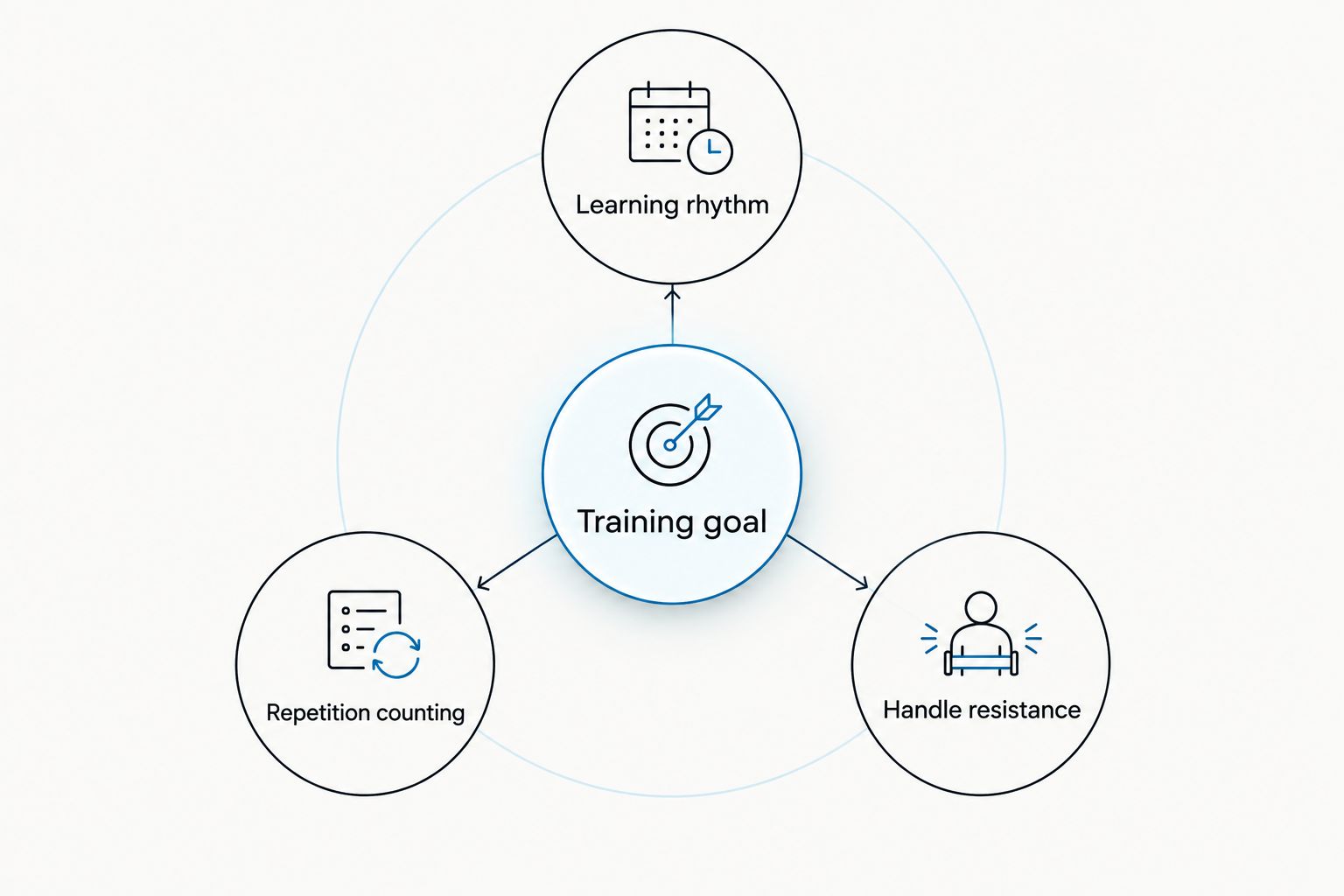
Keep the first decision narrow. Buying a counter, heavier handles, and greater cable resistance all at once makes it harder to identify which feature you actually need.
Check fit before adding effort
Follow the rope manufacturer’s length-setting instructions. There is no reason to force a universal sizing rule onto products with different handle and cable designs.
Then check your training space. You need clearance for the full rope path, not just enough room to stand. Move away from overhead fittings, furniture, other people, and pets before turning the rope.
Inspect the handles, connections, and cable before use. Stop if the equipment is damaged or if skipping causes pain. A repetition target is never a reason to continue through discomfort.
Keep tracking useful
Record the same kind of session consistently. Changing rope type, resistance, and technique together makes a repetition count less useful for understanding your progress.
A higher count is not automatically a better session. Controlled turns and comfortable landings matter more than completing a number with deteriorating form.
How we ranked these beginner options
The 2026 ranking prioritises manageable resistance, fit, weight placement, grip, tracking, and setup. The lightly weighted category takes the default slot because the recommendation centres on learning control rather than adding the most resistance.
The counter-equipped product takes the tracking slot because its name explicitly identifies that feature. Weighted handles receive a separate slot because handle resistance and cable resistance are different choices. Heavy conditioning ropes come last because heavier resistance is not the starting priority here.
This is a feature-based buying guide, not a hands-on performance test or a measured comparison of named competing products.
Which weighted jump rope should you choose?
Choose a manageable, lightly weighted rope if you are undecided. Confirm length, weight placement, and handle comfort before making the purchase.
Choose the Smart Weighted Jump Rope with Electronic Counter when tracking repetitions is your priority, provided the current specifications meet your fit and resistance needs. Choose weighted handles only when you specifically want resistance at the grip.
For beginners shopping in 2026, the practical order is simple: establish control, make training repeatable, then consider additional resistance. Heavy conditioning ropes can wait.
FAQ
What are the best weighted jump ropes for beginners?
The best weighted jump ropes for beginners offer manageable resistance, suitable length, and comfortable handles. A lightly weighted rope is the default category here; choose an electronic counter when repetition tracking is your priority.
Is Sweatjoy’s weighted jump rope a good beginner option?
Sweatjoy’s Smart Weighted Jump Rope with Electronic Counter is a shortlist option for beginners who want repetition counting. Confirm its weight, length, and operating instructions before deciding whether it fits your needs.
Are weighted handles better than a weighted cable?
Neither is universally better: weighted handles concentrate resistance at the grip, while a weighted cable adds resistance to the moving rope. Choose according to the kind of resistance you want rather than comparing total weight alone.
Should a beginner choose the heaviest jump rope?
No. Choose resistance that lets you maintain controlled turns and comfortable landings; a heavy conditioning rope is not the default first purchase.
Does an electronic counter improve skipping technique?
An electronic counter is a tracking feature, not a technique check. Assess shoulder position, rope control, and landings separately from the displayed count.
How do I choose the right weighted jump rope length?
Use the manufacturer’s sizing and adjustment instructions for the specific rope. Check that the rope accommodates your height before buying, and do not assume every weighted model adjusts.
Can weighted skipping replace all my other exercise?
Do not treat weighted skipping as a replacement for every form of exercise. WHO adult activity guidelines include aerobic activity and muscle-strengthening work, so build a routine that addresses both.
One last thing
Check what the weight figure actually measures. A rope’s total weight, each handle’s weight, and the cable’s weight describe different things. Two listings with similar-looking figures can represent different training setups.
Ask that question before comparing features. It is a more useful buying check than choosing whichever rope sounds toughest.