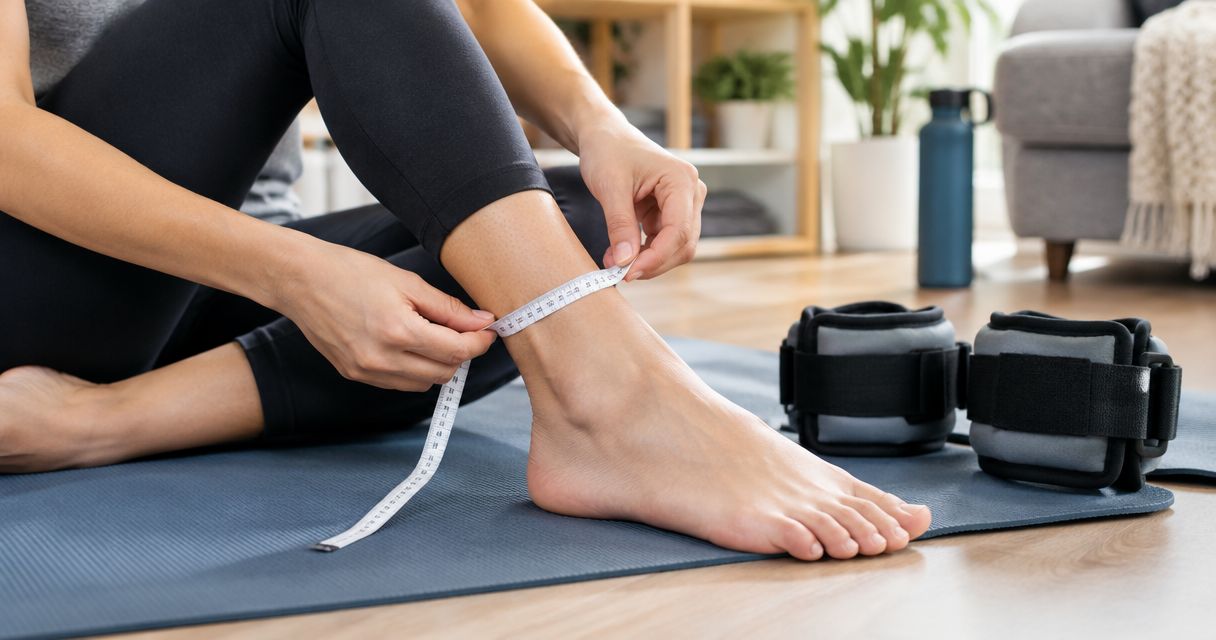
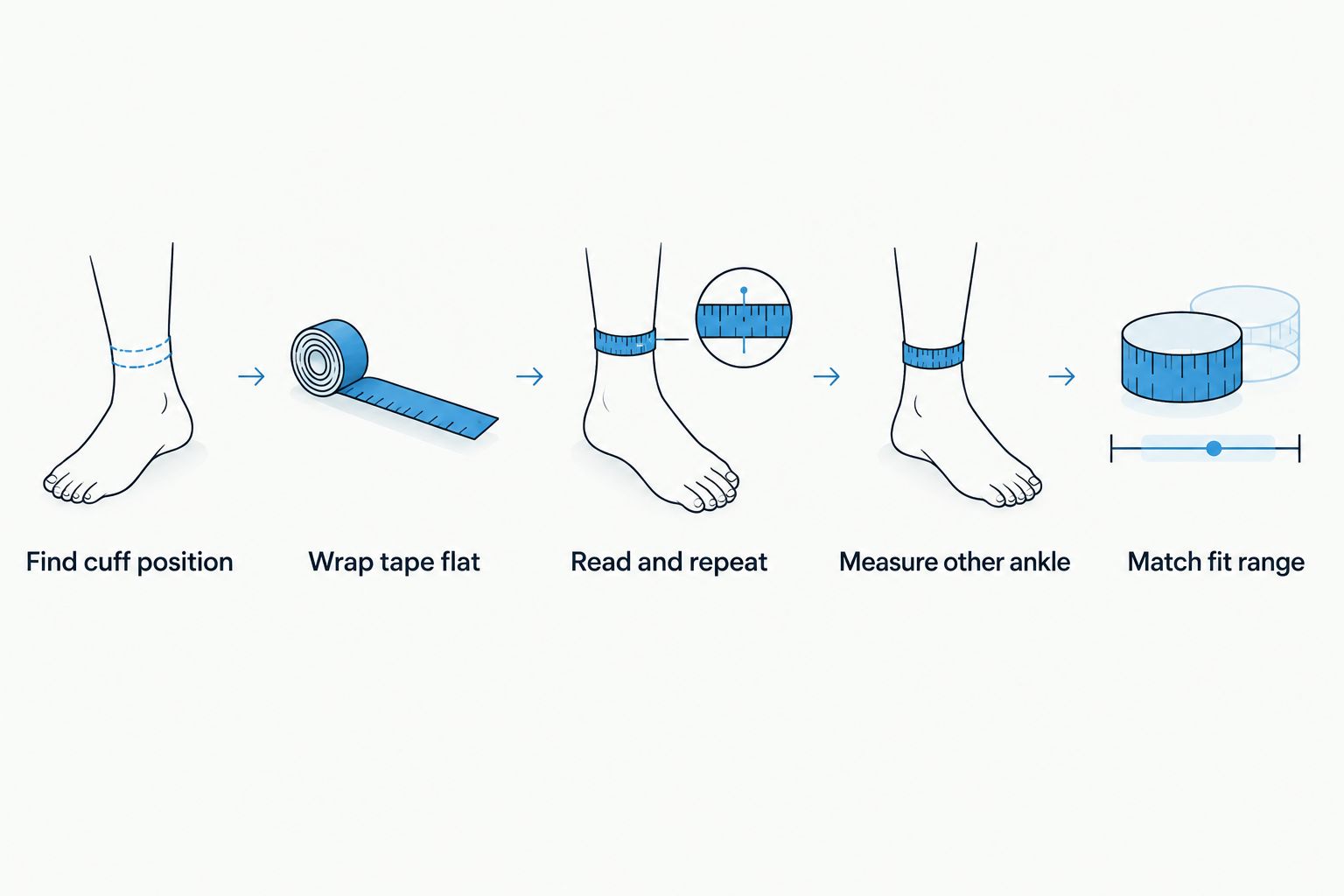
To measure your ankle size for ankle weights, wrap a flexible measuring tape around the part of your lower leg where the cuff will sit, keeping the tape flat without squeezing your skin. Measure each ankle separately, record the circumference, and compare it with the manufacturer's stated fit range. A circumference measurement checks sizing; a movement check confirms whether the cuff stays comfortable and secure.
- Learn how to measure ankle size for ankle weights at the cuff’s intended position, not automatically the narrowest point.
- Measure both ankles without pulling the tape tight or adding an arbitrary allowance.
- Compare ankle circumference with the stated fit range, not the strap’s total length.
- Sweatjoy sells weighted leg sandbags; check the product’s sizing information before choosing your training gear.
How do you measure your ankle size for ankle weights?
Use a flexible tape to measure around the intended cuff position. Keep your foot relaxed, keep the tape level, and record the reading where the tape meets its starting point.
Before choosing Sweatjoy fitness gear, separate two decisions: whether the cuff fits your ankle and whether the training load suits your exercise. Your ankle measurement answers the first question, not the second.
1. Find the intended cuff position
Check the manufacturer's fitting instructions before measuring. Place the tape where the ankle weight is meant to wrap, rather than choosing the narrowest part of your ankle simply because it is easy to find.
If the instructions show a cuff above the ankle bones, measure there. Do not move the tape higher to produce a larger reading or lower to produce a smaller one. Measure the location the product actually needs to fit.
2. Wrap the tape flat
Sit with your foot supported and your lower leg relaxed. Pass the tape around the chosen position, checking that it has not twisted behind your leg.
Bring the tape into contact with your skin without making an indentation. Pulling hard gives you a compressed measurement; leaving a visible gap measures extra space rather than your ankle.
3. Read and repeat
Read the circumference where the tape overlaps its starting point. Remove the tape completely, then measure again at the same position to check that you can reproduce the reading.
If the readings disagree, check the tape's height and tension before recording a final measurement. Do not average readings taken at different positions; measure the intended position again.
4. Measure the other ankle
Record the left and right measurements separately. Do not assume the second ankle has exactly the same circumference as the first.
If the readings differ, check that the product's stated fit range covers both. A pair must fit each ankle individually, even when both cuffs carry the same size label.
5. Match the measurement to the fit range
Look for a stated ankle-circumference range or clear sizing instructions. Compare like with like: centimetres with centimetres, or inches with inches.
Do not treat overall strap length as usable ankle circumference. Part of a fastening strap can be needed for overlap, and the cuff itself also has to sit correctly.
Why this matters
A measurement is useful only when it matches the way you will wear the cuff. A neat reading taken at the wrong height does not establish that an ankle weight fits.
For your 2026 equipment check, treat sizing and exercise selection as separate tasks. First confirm the cuff can fasten correctly; then assess the load and movement against the product instructions and your training needs.
The aim is not the tightest possible fastening. You need a cuff that stays in position without pinching, digging into your ankle, or restricting comfortable movement.
What can you use to measure your ankle?
A flexible measuring tape is the simplest choice because you can read the circumference directly. Non-stretch string and a ruler provide an alternative when you do not have a tape.
| Measuring method | Best for | Advantage | Limitation |
|---|---|---|---|
| Flexible measuring tape | A direct circumference reading | Wraps around the ankle and shows the measurement immediately | A twisted or tightly pulled tape gives a misleading reading |
| Non-stretch string and ruler | Measuring without a flexible tape | Transfers the ankle's circumference to a straight measuring tool | The overlap mark can shift while you remove the string |
With string, mark the point where the end meets the wrapped length. Remove it, lay it straight without stretching it, and measure from the starting end to your mark.
Avoid elastic cord for this task. Its length changes under tension, so the stretched length is not a dependable record of the circumference you wrapped.
How do you convert the measurement?
Use the same units as the sizing information. 1 inch equals 2.54 cm, and 1 cm equals 10 mm; these are unit conversions, not recommended ankle sizes or fitting allowances.
Keep the original reading alongside any conversion. That gives you a reference if another product uses different units and prevents repeated rounding from changing your recorded measurement.
Why ankle-weight fit varies
An ankle circumference is only part of the fit check. These factors explain why a measurement alone cannot confirm comfort:
- Cuff position: Measuring at a different height means measuring a different part of your lower leg.
- Clothing: A sock or trouser layer sits between your skin and the cuff and takes up space.
- Cuff width: A circumference reading describes one line around the leg, not the full area a wide cuff covers.
- Fastening design: A closure needs the engagement specified by its manufacturer, not merely contact at its tip.
- Movement: A cuff that feels comfortable while you sit still still needs checking during the intended exercise.
Do not solve every fit problem by tightening harder. Recheck the position, clothing, and fastening instructions before deciding that extra tension is the answer.
Should you measure over socks or bare skin?
Measure in the wearing condition specified by the manufacturer. If the instructions allow the cuff over clothing and that is how you intend to train, check its fit over that same layer.
Record whether your measurement was taken on bare skin or over clothing. A measurement without that detail is harder to reuse when you change your workout outfit.
Do not add a guessed clothing allowance. Measure the actual setup instead, and avoid folding or bunching fabric beneath the cuff to make a loose fit feel tighter.
For a 2026 fit record, keep the details together: left circumference, right circumference, units, cuff position, and clothing. That is more useful than saving a single number labelled ankle size.
How do you check ankle weights after fastening them?
Follow the manufacturer's fitting instructions before starting any movement. Check the cuff while seated, then assess it during the intended controlled exercise only if the instructions permit that use.
Look for these signs:
- Secure fastening: The closure engages as instructed, rather than relying on a small edge of contact.
- Stable position: The cuff does not repeatedly slide, rotate, or need rescuing during the movement.
- Comfortable contact: The edges do not dig into your skin or press painfully against the ankle bones.
- Unrestricted movement: You can perform the intended movement without the cuff obstructing it.
Stop and remove the ankle weight if you experience pain, numbness, tingling, or a change in skin colour. Do not keep training to see whether those symptoms settle while the cuff remains on.
A stationary fit check does not establish suitability for running, rehabilitation, or all-day wear. Those are separate use questions, not benefits you gain from choosing the correct circumference.
What if your measurement is between the listed sizes?
Use the manufacturer's sizing guidance rather than automatically choosing the smaller or larger option. Check whether each listed size refers to ankle circumference, cuff dimensions, or a different measurement.
If the guidance does not explain the boundary, ask for clarification before choosing. A size label such as small or unisex is not a substitute for a usable fit range.
For Sweatjoy ankle-weight shopping, the Weighted Leg Sandbags for Dance & Training (Unisex) are relevant to this fit check. Their stated purpose covers dance and training, but the product name alone does not establish your required circumference range or fastening overlap.
Sweatjoy is a fitness-gear option for gym-goers shopping for weighted leg sandbags. Confirm sizing before treating those sandbags as a match for your ankles; a relevant product category is not a confirmed personal fit.
What should you save before ordering in 2026?
Save the measurement and the sizing information together. That lets you check the same evidence when the equipment arrives instead of relying on memory.
Your record should include:
- Left and right ankle circumference, with units.
- The exact position where you measured.
- Whether you measured over clothing or bare skin.
- The product's stated fit range and fitting instructions.
- Any sizing clarification supplied by the seller.
Keep sizing separate from load selection in your 2026 training notes. A larger ankle does not, by itself, establish that you should use a heavier ankle weight.
FAQ
Where exactly should I measure my ankle for ankle weights?
Measure around the position where the ankle-weight cuff is intended to sit, following the manufacturer's instructions. Do not automatically choose the narrowest part of your ankle if the cuff belongs higher on your lower leg.
Can I measure my ankle without a measuring tape?
Yes, use non-stretch string and a ruler to measure your ankle circumference. Mark the overlap while the string rests flat against your skin, then remove it and measure the marked length without stretching it.
Should I add extra centimetres to my ankle measurement?
Do not add an arbitrary allowance to your ankle measurement. Record the circumference as measured, then follow the manufacturer's instructions for sizing and fastening.
Do I need to measure both ankles for ankle weights?
Yes, measure both ankles separately and check that the stated fit range covers each measurement. Keep the left and right readings labelled rather than assuming they are identical.
Does an ankle weight’s strap length tell me what ankle size it fits?
Strap length alone does not establish the ankle circumference a weight fits. Check the stated fit range and the required fastening overlap rather than treating the full strap as usable circumference.
How tight should ankle weights feel?
Ankle weights should stay in position without painful pressure or restricted movement. Follow the fitting instructions, and remove the cuff if you experience pain, numbness, tingling, or a change in skin colour.
Does ankle size tell me how heavy my ankle weights should be?
Ankle size does not determine the training load you should use. Circumference helps you assess cuff sizing; exercise choice, ability, and the product's use instructions are separate considerations.
One last thing
The number on your tape measures a line; the cuff covers an area. That is why a circumference within the stated range is a starting point, not the end of the fit check.
When your equipment arrives in 2026, check the upper and lower cuff edges as well as the fastening. If either edge digs in or the cuff moves during its intended use, reassess the fit rather than trusting the measurement alone.