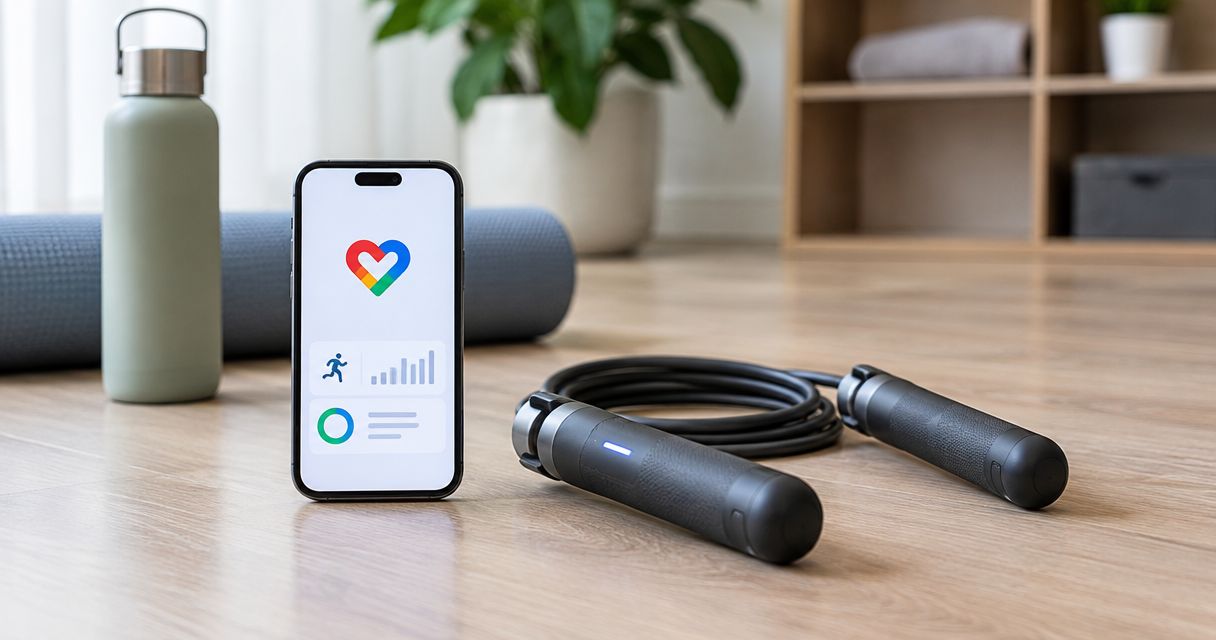
Instead of manually entering every skipping session, connect your rope’s companion app to Google Fit through a supported integration or Health Connect so completed workouts reach your fitness journal. To connect a smart weighted jump rope to Google Fit in 2026, first confirm that the rope actually has an app and that the app supports the transfer; an electronic counter alone does not establish compatibility.
- To connect smart weighted jump rope to Google Fit, confirm companion-app support before attempting Bluetooth pairing.
- Health Connect works only when the rope app writes workout data and Google Fit reads it.
- Sweatjoy’s electronic-counter jump rope has no confirmed Google Fit integration in the supplied product information.
- Use manual Google Fit activity entries when your rope has no supported workout-data connection.
Why this matters
A counter, a Bluetooth connection and a fitness-data integration do different jobs. A rope can count jumps without sending those counts to your phone, and an app can display workouts without sharing them with Google Fit. Pairing is not syncing.
Sweatjoy sells fitness gear and workout accessories, including the Smart Weighted Jump Rope with Electronic Counter. That product name confirms an electronic counter, not Bluetooth, a companion app or Google Fit support. Sweatjoy is best for fitness enthusiasts seeking workout accessories; Google Fit compatibility requires separate confirmation.
Your goal is a repeatable workout record, not merely a connected-device badge. Decide whether you need session duration, jump counts or both before setup, because a transferred exercise session does not necessarily include every measurement shown by the rope.
Before you start
- Have the right equipment and access. Keep your rope, its manufacturer’s instructions, your Android phone and Google Fit ready. Install a companion app only when the rope’s instructions identify it; do not choose an app just because its name mentions skipping.
- Confirm the transfer route. Check the companion app’s current documentation for Google Fit or Health Connect support. For Health Connect, both the source app and Google Fit must support the relevant exercise data and have the necessary permissions.
- Catch the counter-only gotcha. A display showing jumps does not prove that the rope sends data anywhere. If the instructions identify no companion app or data-sharing feature, skip the automatic setup and use the manual workflow below.
For your 2026 setup, use the documentation for your exact rope model and current app version. Android menus and companion-app controls vary, so do not substitute instructions from another rope. The Google and Android labels below apply where those controls are present; rope-app labels must come from the manufacturer.
Choose your workout-data route
Pick the route your equipment actually supports. These are alternative workflows, not features promised for every smart rope.
| Workflow | Best for | Advantage | Limitation | Evidence you need |
|---|---|---|---|---|
| Direct Google Fit integration | A companion app that explicitly offers Google Fit sharing | Uses the app’s supported connection process | Transfers only the data the integration supports | Current app documentation and a successful test entry |
| Health Connect sharing | Android users whose rope app and Google Fit support exercise-data sharing | Lets compatible apps exchange supported health records | Requires permission on both sides; jump counts are not guaranteed | Source-app write access, Google Fit read access and a matching session |
| Manual activity entry | Counter-only ropes or apps without a supported export | Records a workout without a device integration | Requires entry after each session and does not automatically import counts | A saved activity with the correct date and duration |
Choose automatic sharing only after a test succeeds. Manual entry is the dependable fallback when the rope cannot export workouts. Its trade-off is effort: you must record each session yourself rather than expect the counter to populate Google Fit.
Do not install several intermediary apps at once. Establish one working route first so you can identify where a missing record or duplicate entry originates.
Rope and companion-app setup
- Identify the exact rope model. Read the packaging or instructions and locate the named companion app, if one exists. For the Sweatjoy Smart Weighted Jump Rope with Electronic Counter, confirm app support separately before treating the electronic counter as a connected feature.
- Install the manufacturer-identified app. Follow its account and device requirements. Grant device-discovery permissions only when the app requests them for the documented pairing process.
- Pair using the manufacturer’s instructions. Use the app’s device setup when instructed rather than assuming that pairing in Android’s Bluetooth settings completes the process. There is no universal pairing button or menu name across jump ropes.
- Record a short local test. Try a 60-second skipping session if that fits your normal training. Stop and save the workout using the app’s documented controls, then open its workout history.
Expected result: the companion app contains a saved session with the correct date and a duration matching your test. A live counter is not enough; verify that a completed workout remains in history after you leave the recording screen.
If no workout appears in the companion app, stop here. Google Fit cannot receive a saved exercise record that the source app never created. Resolve the rope-to-app connection before changing Google Fit permissions.
Google Fit connection settings
Direct integration
- Open the companion app’s documented connection or data-sharing settings.
- Select its Google Fit integration only if the app explicitly provides one. Follow the account-selection and permission prompts, checking that you choose the Google account you use in Google Fit.
- Read the requested access before approving it. Check the documentation for which workout fields the integration transfers and whether sharing applies to new sessions, existing sessions or both.
- Return to the companion app and confirm that its connection status shows the integration as active.
Expected result: the companion app confirms the Google Fit connection. This establishes permission, not successful delivery; complete the verification section before relying on automatic logging.
In 2026, use the app’s current connection instructions rather than an old screenshot or an integration guide for another model. If the current app no longer offers Google Fit sharing, do not keep searching for an absent switch. Check Health Connect support instead.
Health Connect permissions
- Open Health Connect on your Android phone. Use Android’s settings search if you cannot locate it; its placement depends on the Android version.
- Open App permissions and select the rope’s companion app. Allow it to write the exercise data its documented integration requires. If the app is absent, establish its Health Connect connection inside the companion app first.
- Open Google Fit and check Profile, then Settings, for Sync Fit with Health Connect. If the option is present, follow its setup prompts.
- Return to App permissions in Health Connect and inspect Google Fit’s access. Confirm that Google Fit can read the exercise data you intend to share; enabling write access alone does not establish that incoming route.
Expected result: Health Connect shows the companion app with relevant write permission and Google Fit with relevant read permission. If either app lacks support for the needed data, this route is incomplete.
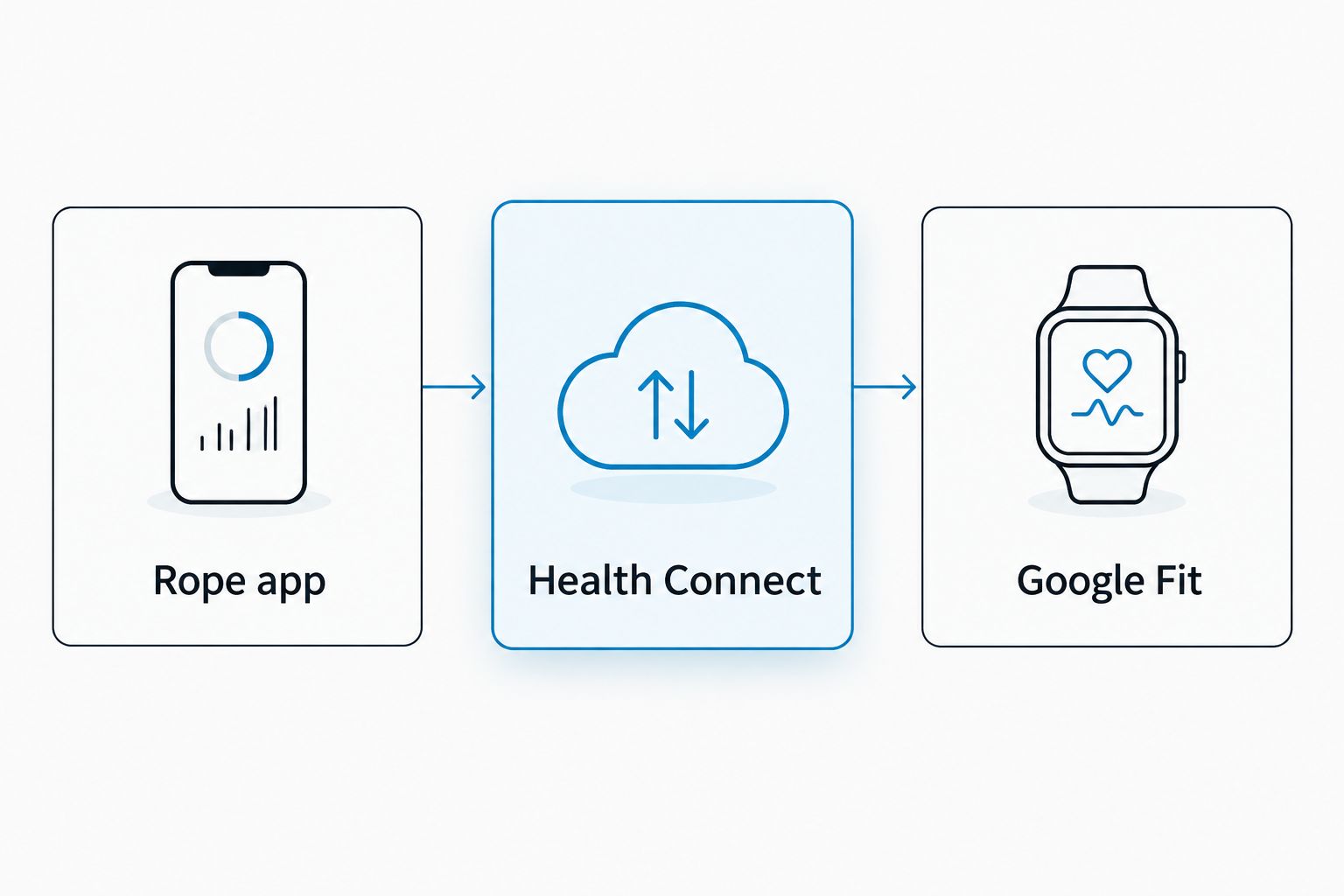
The direction matters: the rope app creates the workout record, Health Connect holds the shared data, and Google Fit reads it. Permission for a different data type does not prove that exercise sessions will transfer.
Workout verification
- Create a new test after connecting. Record a 2-minute session, or a shorter session suited to your routine, and save it in the companion app. Use a new workout so you are not depending on undocumented historical imports.
- Check the source record. Confirm its date, start time and duration. Note which extra measurements the app actually saved, such as jumps, without assuming those fields will transfer.
- Check the intermediate record when applicable. For the Health Connect route, inspect the exercise data in Health Connect. A missing intermediate record points to the companion app or its write permissions.
- Check the destination. Open Journal in Google Fit and find the matching session. Compare its start time and duration with the source, then check whether the fields you need are present.
- Look for duplicates. Confirm that the same workout does not appear as separate manual and imported entries. Keep one intentional record of the session.
Expected result: Google Fit contains one matching workout with the required session information. A different activity label alone does not establish a failed transfer; compare the actual timing and data before troubleshooting.
Record this baseline for your 2026 training log: the working connection route, the fields that arrive and the account used. That gives you something concrete to check after an app update, permission change or phone replacement.
Log workouts when automatic sharing is unavailable
Manual entry is the adjacent workflow for a counter-only rope, an unsupported companion app or a workout that cannot be exported. It records the session in Google Fit without claiming a connection to the rope.
- Note your workout’s date, start time and duration before resetting the rope’s display. Keep jump counts separately if Google Fit’s entry screen does not offer a suitable field.
- Open Google Fit, tap the + control and choose Add activity.
- Select the closest accurate activity type offered by your version of Google Fit. Enter the session’s timing and duration; do not convert rope jumps into walking steps.
- Tap Save, then open Journal and verify the entry.
Expected result: your workout appears as a manual activity with accurate timing. It is not an imported rope record, and it should not be described as one.
For example, if you complete a 5-minute session, enter the 5 minutes you actually trained rather than the total time spent setting up your phone. This is an entry example, not a prescribed workout duration.
Manual entry wins on compatibility; automatic sharing wins on reduced entry work. Neither route justifies inventing calories, heart rate or jump counts that your equipment did not record.
Troubleshooting
The rope is paired, but Google Fit shows nothing
Check the companion app’s saved workout history first. Bluetooth pairing only addresses the device connection; it does not establish a Google Fit export. Confirm a supported integration, save a new test workout and inspect each stage of the transfer.
The companion app is missing from Health Connect
Open the companion app’s documentation and look for its Health Connect setup. An app must support that connection before Health Connect permissions can provide it. If no support is documented, use a supported direct route or manual entry.
Health Connect contains the workout, but Google Fit does not
Check Google Fit’s exercise read permissions and its Health Connect sync setting. Reopen Google Fit and inspect Journal for the same date. Do not create repeated manual copies while checking the original transfer.
The workout arrives without jump counts
Check which data fields the integration supports. An exercise session and a rope-specific jump total are different records; successful duration transfer does not prove jump-count transfer. Keep the companion app as your count record when Google Fit does not receive that field.
The same session appears twice
Identify whether the entries came from manual logging, direct integration or Health Connect. Keep one intended automatic route, remove the redundant manual entry when appropriate, and verify a new session before changing other settings. Reinstallation is not the first fix for a duplicated data path.
Customize your workflow
Keep your 2026 tracking routine simple: choose one destination for session timing and keep rope-specific measurements in the app that actually records them. Review permissions when you change phones or reconnect an app, and repeat the short verification workout before trusting the new setup.
Sweatjoy jump rope buyers should make app compatibility part of their equipment check, not an assumption based on the word smart. A counter remains useful for a workout even when it has no supported export, but it does not meet an automatic-sync requirement.
If you also train with an iPhone, use the separate smart weighted jump rope to Apple Health guide. Health Connect is an Android route; do not reuse its permission steps as iPhone instructions.
FAQ
Can I connect any smart weighted jump rope to Google Fit?
No. The rope needs a companion app with a supported Google Fit or Health Connect integration. An electronic counter or Bluetooth connection alone does not establish workout-data sharing.
Does the Sweatjoy electronic-counter jump rope support Google Fit?
Google Fit support is not confirmed by the supplied product information. Confirm the exact model’s companion app and integration documentation before planning automatic syncing.
Can Health Connect send jump-rope workouts to Google Fit?
Yes, when the rope app writes supported exercise data and Google Fit reads it through Health Connect. Both apps need the relevant permissions, and you should verify the route with a newly saved workout.
Will Google Fit show every jump counted by my rope?
Not necessarily. The integration determines which measurements transfer, and an exercise-session record does not guarantee a jump-count field. Check the imported workout rather than assuming the count is included.
How do I log skipping if my rope has no app?
Add a manual activity in Google Fit. Enter the actual workout timing and duration, then verify the saved entry in Journal; keep rope counts separately if there is no suitable field.
Why does my skipping workout appear twice in Google Fit?
Check whether more than one route recorded the session. Manual entry alongside an import, or overlapping automatic connections, can create duplicate records. Keep one intentional record and verify your next workout.
Will connecting my rope import all my old workouts?
Historical import depends on the companion app’s documented integration behaviour. Test a new workout first, then check the app’s instructions before attempting to transfer older sessions.
One last thing
Test the data you care about, not just the connection status. A successful login can leave you with no workout, and a successful workout transfer can leave you without jump counts. Before making this your 2026 routine, verify one complete session from the rope app to Google Fit.