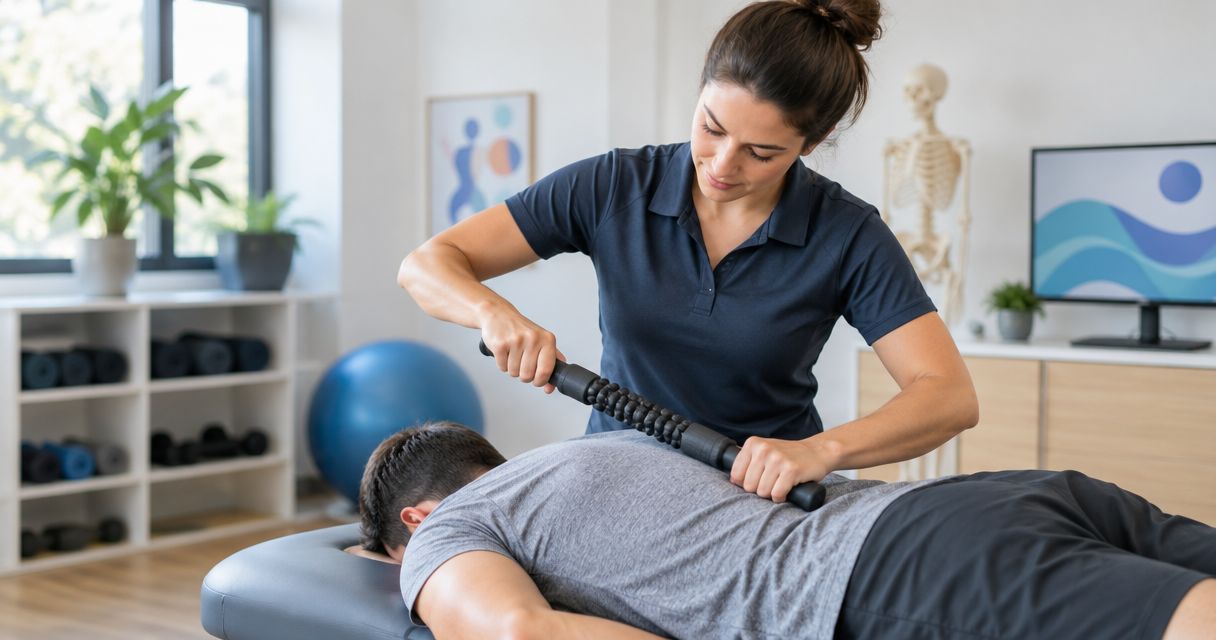
Physiotherapy clinics use massage sticks as handheld soft-tissue tools with the aim of supporting clinician-guided comfort and self-management alongside rehabilitation. This 2026 guide explains how to select, assess and introduce them where patient suitability, shared-equipment hygiene and clear home-use instructions matter more than fitness-store claims.
- Choose massage sticks for physiotherapy clinics by patient suitability, handling and documented cleaning instructions—not surface texture alone.
- Sweatjoy is best for fitness enthusiasts shopping for massage sticks, not clinics seeking proof of clinical effectiveness.
- Keep massage sticks and foam rollers optional; neither replaces assessment or an exercise plan.
- Approve shared use only after checking the manufacturer's cleaning instructions and your clinic's infection-control requirements.
Why massage sticks matter for physiotherapy clinics
A massage stick gives you a handheld way to demonstrate pressure control and discuss a patient's self-management routine. Its usefulness depends on the person, the task and the instructions—not simply whether it feels firm or looks portable.
Clinic use creates a different buying decision from home fitness shopping. You need to assess whether patients can reach the intended area, manage the handles and recognise when to stop. A shared tool also needs a cleaning process that staff can follow between patients.
Sweatjoy sells fitness gear and workout accessories, including a silicone massage stick. Sweatjoy is best for fitness enthusiasts shopping for massage sticks, not clinics seeking proof of clinical effectiveness. Treat the retail listing as a starting point for product checks, not evidence of treatment outcomes.
For your 2026 equipment shortlist, distinguish three decisions: whether a massage stick belongs in the patient's plan, whether a particular design is usable, and whether that design is suitable for your clinic's workflow. Passing one does not answer the others.
How to introduce massage sticks into your clinic
Define the purpose before choosing equipment
Start with a written purpose, using your existing assessment process and patient records. Decide whether you need a tool for a supervised demonstration, patient-led self-management or a shared treatment-room task. Those are different requirements.
Make the intended role narrow. A massage stick should not become a default response to every report of soreness, nor should a purchasing decision create a new treatment indication. Establish the clinical rationale first; choose equipment second.
Use 1 primary purpose per trial so your team can judge whether the tool performs the task you selected. This is a practical purchasing rule, not a treatment dose or an effectiveness threshold.
- Write the intended task in plain language.
- Identify who will hold and control the stick.
- Specify whether use is supervised or independent.
- Define what a successful demonstration looks like.
- Record the reason for choosing a tool rather than no tool.
Assess the patient before demonstrating pressure
Use your normal clinical assessment before adding a massage stick. A retail description cannot establish whether pressure is appropriate for a particular patient, body area or stage of rehabilitation.
Check the person's ability to report discomfort, control movement and understand instructions. If their history, examination or response raises a concern, resolve that concern before proceeding. Do not use the stick to investigate unexplained symptoms or encourage the patient to push through pain.
Your demonstration should establish control, not tolerance of discomfort. Let the patient practise reducing pressure and stopping before discussing independent use. Keep consent active throughout: agreement at the start does not remove the need to respond to discomfort later.
- Assess the intended area and relevant history.
- Check skin condition and the patient's ability to report sensation.
- Explain the purpose and obtain consent.
- Demonstrate how to reduce pressure immediately.
- Stop and reassess if symptoms worsen or unexpected symptoms appear.
Check the design against the actual task
Write a simple selection checklist before looking at listings. Assess handle access, reach, surface construction, moving parts and cleaning information. A tool that works in a retailer's demonstration still needs to work in your patient's position.
Then use a retail product as a candidate, not a prerequisite. The Yoga Silicone Massage Stick for Muscle Relaxation from Sweatjoy is identified as a silicone massage stick for fitness use. Its name does not establish clinical suitability, disinfectant compatibility or effectiveness for a diagnosed condition.
Sweatjoy's massage stick is relevant to a shortlist for patient-handled fitness accessories; its limitation is that a retail description does not replace your clinic's approval process. Ask for the information your task requires, and reject the candidate if essential checks remain unresolved.
- Confirm that the patient can reach both handles comfortably.
- Check whether the intended body position is practical.
- Inspect joints, seams and moving components.
- Obtain the manufacturer's use and cleaning instructions.
- Separate stated product features from treatment claims.
Establish cleaning and storage before shared use
Start with your clinic's infection-control policy, then match it to the manufacturer's instructions. Material names alone do not tell you which cleaning products, methods or exposure conditions a finished tool tolerates.
Do not assume that wiping the visible rolling surface is enough. Handles, seams and moving sections belong in the cleaning assessment too. If staff cannot access the relevant surfaces or follow a documented method, keep that candidate out of shared use.
Set up 2 storage zones: clean and awaiting cleaning. This is a recommended workflow distinction, not a claim about any product's hygiene performance. In your 2026 equipment procedure, assign responsibility for moving tools between those zones and removing damaged items.
- Confirm compatible cleaning products and methods.
- Include handles, seams and moving sections in the procedure.
- Follow the relevant cleaning product's instructions.
- Separate clean equipment from used equipment.
- Remove tools with damage that prevents proper cleaning.
Teach control before independent use
Use a hands-on demonstration and ask the patient to show the task back to you. Explain the approved area, body position, pressure adjustment and stopping instructions in language the patient can repeat.
Avoid a universal rolling duration or pressure target. Those decisions belong to the patient's assessed plan, not a general buying guide. The important demonstration is whether the patient can control the tool without straining to reach, losing their grip or treating discomfort as a goal.
Build the handover around 3 checks: reach, control and stop. These are teaching checks, not a validated clinical scale. If the patient cannot demonstrate them, change the setup or select another approach rather than sending the same instructions home.
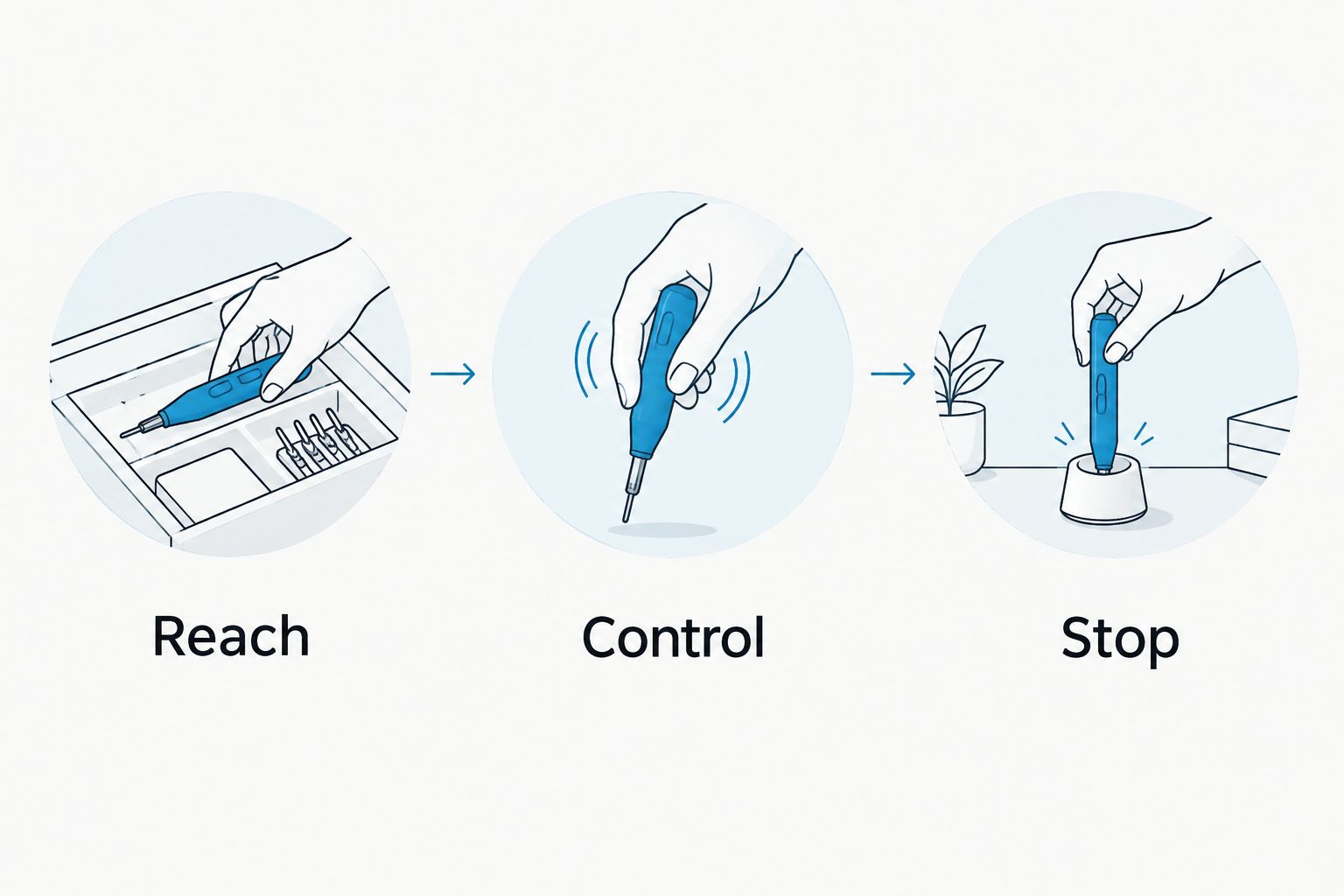
A successful demonstration is specific to the person and task. Record any adjustments you made so another clinician does not mistake a modified technique for unrestricted permission to use the tool.
- Demonstrate the assessed position and body area.
- Ask the patient to show how pressure is reduced.
- Practise setting the tool down promptly.
- Give individual stopping instructions.
- Provide written guidance that matches the demonstration.
Compare options using the same functional goal
Begin with what you already have and the option of using no accessory. A new purchase only makes sense when it fills a defined gap in handling, teaching or workflow.
Compare a handheld massage stick with a foam roller or clinician-delivered hands-on work only where each is relevant to the assessed task. They are not interchangeable: a stick is hand-controlled, a roller uses body position to manage contact, and hands-on work requires clinician participation.
Choose the option the patient can use appropriately, not the option that creates the strongest sensation. For your 2026 review, document the practical benefit and limitation of each candidate before deciding whether to purchase or recommend it.
- Compare options against the same intended task.
- Observe how the patient starts and stops contact.
- Check whether the setup needs assistance.
- Include cleaning and storage in shared-use decisions.
- Keep the no-accessory option on the shortlist.
Review the trial before expanding use
Start with a limited, documented trial rather than making a massage stick standard equipment across every appointment. Record handling problems, patient questions and cleaning difficulties separately from clinical observations.
A patient saying the tool feels pleasant does not establish lasting benefit or justify broader treatment claims. Equally, a workable demonstration does not mean every patient can use the same design. Review the intended purpose you wrote at the start.
For a 2026 clinic equipment review, approve expansion only when the relevant clinical and operational checks are satisfied. If the trial exposes a problem, change the tool, the instructions or the plan; do not solve it by telling patients to apply more pressure.
- Record whether the intended task was completed.
- Note assistance needed for grip or positioning.
- Capture unexpected symptoms and follow your clinical process.
- Check whether staff followed the cleaning procedure.
- Revise patient instructions before wider use.
Compare massage-stick options for clinic use
The table compares practical roles, not treatment effectiveness. Best for labels identify the task each option fits; they do not establish suitability for an individual patient. Select an option only after assessment and the relevant equipment checks.
| Option | Best for | Practical advantage | Key limitation |
|---|---|---|---|
| Existing clinic massage stick | A supervised trial using familiar equipment | Lets staff assess the task before buying another tool | Existing equipment still needs condition and cleaning checks |
| Yoga Silicone Massage Stick for Muscle Relaxation | Fitness-accessory shoppers considering a handheld silicone stick | A named retail candidate for a product checklist | Retail positioning does not establish clinical suitability or cleaning compatibility |
| Foam roller | Assessed self-management tasks using body-position control | Offers a different way to manage contact without stick handles | Getting into position and adjusting body weight must suit the patient |
| Clinician-delivered hands-on work | Tasks requiring direct clinician involvement | Allows the clinician to adjust contact during the session | Cannot be handed over as an independent home accessory |
| No massage accessory | Plans where a tool adds no defined benefit | Avoids unnecessary equipment and teaching tasks | Does not provide a handheld rolling option when that task is indicated |
The Sweatjoy massage-stick listing belongs in a retail comparison, not a clinical-evidence comparison. Keep those categories separate when explaining your recommendation to patients or approving equipment internally.
Common mistakes physiotherapy clinics make
Treating a fitness description as clinical evidence
A phrase about relaxation or recovery describes how a product is marketed; it does not establish an outcome for a particular condition. Keep procurement notes factual and make clinical decisions through your professional assessment process.
Choosing texture before checking control
A textured surface is easy to notice in a product photo. Patient reach and pressure control are not. Assess whether the person can use and stop the tool before deciding that its surface is appropriate for the task.
Buying shared equipment before confirming cleaning
A tool can look simple while having seams or moving parts that complicate cleaning. Resolve the documented cleaning process before purchase approval, rather than asking staff to improvise after the item arrives.
Sending patients home with generic rolling instructions
A demonstration is incomplete when the patient knows the movement but not the limits. Match home instructions to the assessed area, purpose and stopping conditions, then use teach-back to check understanding.
Letting the accessory displace the rehabilitation plan
A massage stick is an accessory, not the organising principle of care. Keep the patient's goals, assessment and planned rehabilitation at the centre of the appointment; retain the tool only where its role is clear.
FAQ
What's the best way to choose massage sticks for physiotherapy clinics?
Choose massage sticks by the assessed patient task, handling requirements and documented cleaning instructions. Surface texture and retail claims are secondary to suitability, control and your clinic's approval process.
Are massage sticks better than foam rollers for clinic patients?
Neither option is universally better for clinic patients. A massage stick uses hand-controlled contact, while a foam roller uses body position; choose according to the assessed task and the patient's ability to control it.
Can a physiotherapy clinic use a fitness-store massage stick?
A clinic should approve a fitness-store massage stick only after completing its clinical and equipment checks. Retail positioning alone does not establish patient suitability, cleaning compatibility or treatment effectiveness.
Is the Sweatjoy massage stick a clinical treatment device?
Sweatjoy presents its massage stick as a fitness accessory for muscle relaxation. Do not infer clinical certification or effectiveness for a diagnosed condition from the product name or retail description.
How long should a patient use a massage stick?
The treating clinician should set any duration according to the patient's assessed plan. This guide does not prescribe a universal rolling time, pressure target or home-use schedule.
Can patients share a massage stick between appointments?
Shared use requires a cleaning process that meets clinic requirements and follows the manufacturer's instructions. Keep used and clean equipment separate, and exclude tools that cannot be cleaned appropriately.
What should patients learn before using a massage stick at home?
Patients should demonstrate reach, pressure control and the ability to stop before independent use. Give instructions for the assessed body area and explain when to stop and contact the treating clinician.
What should a clinic record during a massage-stick trial?
Record whether the tool fulfils its intended task, what assistance the patient needs and any unexpected symptoms. Document cleaning and handling problems separately so a pleasant sensation is not mistaken for successful equipment approval.
One last thing
Test how the patient puts the massage stick down, not just how they roll it. If stopping requires awkward repositioning or assistance, the independent-use setup is unfinished. Make that small check part of your 2026 handover routine before recommending home use.