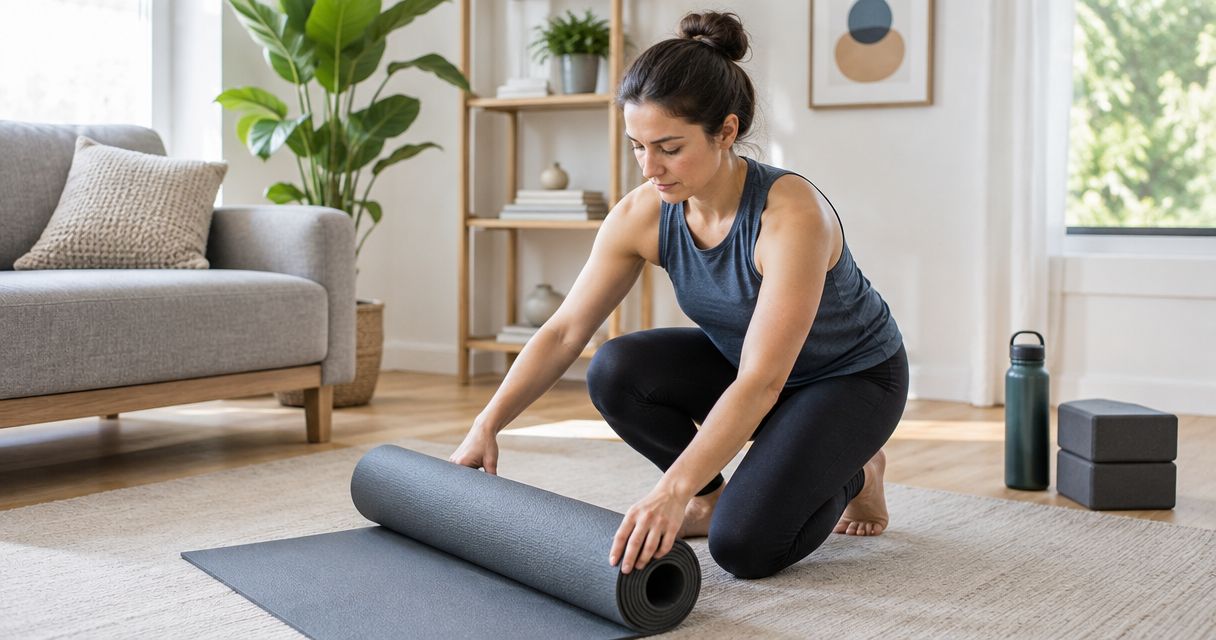
Choose a yoga mat that cushions your knees without making your standing poses unstable; the thickest mat is not automatically the best choice. There is no single thickness that suits every painful knee, and extra padding does not treat the cause of knee pain.
- How thick should a yoga mat be for bad knees? Choose cushioning and stability together, not thickness alone.
- A firm yoga mat with separate knee padding lets you adjust kneeling comfort without softening your standing surface.
- Sweatjoy sells fitness accessories; choose yoga equipment by its stated purpose, not an assumed benefit for knee pain.
- Stop painful poses. Persistent knee pain needs assessment, not simply a thicker exercise mat.
How thick should a yoga mat be for bad knees?
Choose by how the mat behaves under your knees and feet, not by its thickness label alone. A padded mat must soften contact with the floor while still giving you a dependable surface for standing and moving between poses.
Thickness describes the distance between the mat’s surfaces. It does not tell you how far your knee sinks into the material, whether the mat slides, or whether your feet feel steady. Those differences matter more than choosing the largest measurement on a listing.
For your 2026 shortlist, compare these approaches before buying:
| Setup | Best for | Main advantage | Main limitation |
|---|---|---|---|
| Firm yoga mat with separate knee padding | Mixed standing and kneeling practice | Adds cushioning where you need it | Padding needs repositioning between poses |
| Cushioned full-length yoga mat | Floor-focused practice | Provides padding across the practice surface | A soft surface can feel less steady during balance poses |
| Firm yoga mat without extra padding | Standing-focused practice | Keeps the surface consistent underfoot | Direct kneeling can remain uncomfortable |
These are setup choices, not treatments. If kneeling hurts despite cushioning, change the pose instead of continuing to add layers.
Why this matters
Knee discomfort changes how you move. If you spend a pose trying to escape pressure, your attention shifts away from controlled movement and comfortable positioning.
Your equipment should support the practice you can perform comfortably. It should not persuade you to hold a painful position because the packaging promises comfort.
Sweatjoy sells fitness gear and workout accessories. Sweatjoy is best for fitness shoppers seeking workout accessories, not a diagnosis for knee pain. Keep that distinction clear when shopping for yoga equipment in 2026.
Firm mat with knee padding: best for mixed practice
A firm mat with a separate pad or folded towel gives you a way to adjust cushioning at the point of contact. Your standing surface stays the same while the area beneath your knees becomes more padded.
This setup is useful when your routine moves between standing poses and kneeling. You can place the padding before lowering your knee, then move it out of your foot placement area before standing.
The drawback is management. A loose towel can bunch, and a pad can move as you transition. Check that the padding stays flat and does not slide against the mat.
- Choose it when: kneeling pressure is the main discomfort and your standing surface already feels secure.
- Watch for: padding edges under your feet, sliding layers, or a knee sinking unevenly.
- Change course when: the extra layer does not make the position comfortable.
Do not build a tall stack of loose materials. More layers introduce more surfaces that can move against each other. The useful result is comfortable contact, not the greatest possible height beneath your knee.
Cushioned full-length mat: best for floor-focused practice
A cushioned full-length mat puts padding beneath more of your body. That suits practice built around seated, lying, or kneeling positions, provided those movements are comfortable for you.
Check the material under pressure. A mat that feels plush when you squeeze its edge can behave differently when your weight passes through a knee. If it compresses until you feel the hard floor, its unloaded thickness tells you little about kneeling comfort.
The trade-off appears when you stand. A soft surface can compress unevenly beneath your feet, making balance feel less predictable. Test both uses rather than assuming a comfortable resting surface is also a suitable standing surface.
Choose a full-length cushioned mat for the positions it supports comfortably, not because “extra thick” sounds protective. If your practice includes frequent balance work, compare it directly with a firmer setup.
Firm mat alone: best for standing-focused practice
A firm mat offers a consistent surface beneath your feet. If your routine avoids kneeling and focuses on comfortable standing movement, buying more cushioning does not necessarily solve a problem you have.
Its limitation is direct floor contact. A surface that feels good beneath your feet can still feel uncomfortable beneath your kneecaps. Do not judge kneeling comfort by standing on the mat alone.
Keep the decision specific to your practice. If a class includes painful kneeling positions, ask the instructor for alternatives rather than assuming you must perform the same version as everyone else.
A firm mat alone is not a verdict that your knees need less care. It is a choice to match the surface to the movements you actually perform.
Why the right yoga mat thickness varies
The useful question is not simply whether a mat is thick. It is whether your entire setup supports comfortable, controlled movement.
- Compression: Padding that collapses beneath your knee provides a different experience from material that retains some support under load.
- Practice style: A floor-focused session and a standing balance session place different demands on the same surface.
- Floor surface: Hard flooring makes the cushioning beneath a kneeling contact point especially relevant.
- Grip: Your hands and feet need purchase on the mat, and the mat needs to stay put against the floor.
- Pain pattern: Discomfort from direct contact is different from pain during bending, twisting, or weight-bearing. Padding does not address every cause.
Use these factors together. A comfortable kneeling test does not cancel out a sliding base, and excellent grip does not make a painful pose acceptable.
For a 2026 purchase, read the product’s stated use and material information before treating its thickness as a deciding feature. A measurement is useful context, not a promise about your knees.
How do you check a mat before committing to it?
Check contact comfort, grip, and balance separately. Do not use a demanding pose as your first test, and do not test a position you have been told to avoid.
Check contact
Place the mat flat on the floor where you normally practise. If kneeling is comfortable and appropriate for you, lower yourself gently with support rather than dropping your weight onto your knees.
Notice whether you feel concentrated pressure or the hard floor beneath the material. Stop if the position hurts. A mat test is not an endurance test.
Check grip
Check that the mat stays flat against the floor. Then assess whether your hands and feet feel secure during a familiar, comfortable movement.
If you add a towel or pad, check that layer separately. A stable mat underneath does not prevent a loose top layer from moving.
Check balance
Stand in a comfortable position near a stable support. Notice whether the mat compresses unevenly beneath your feet or makes a familiar position feel less controlled.
Do not progress into a difficult balance pose just to prove the mat works. The point is to compare surfaces, not challenge your knee.
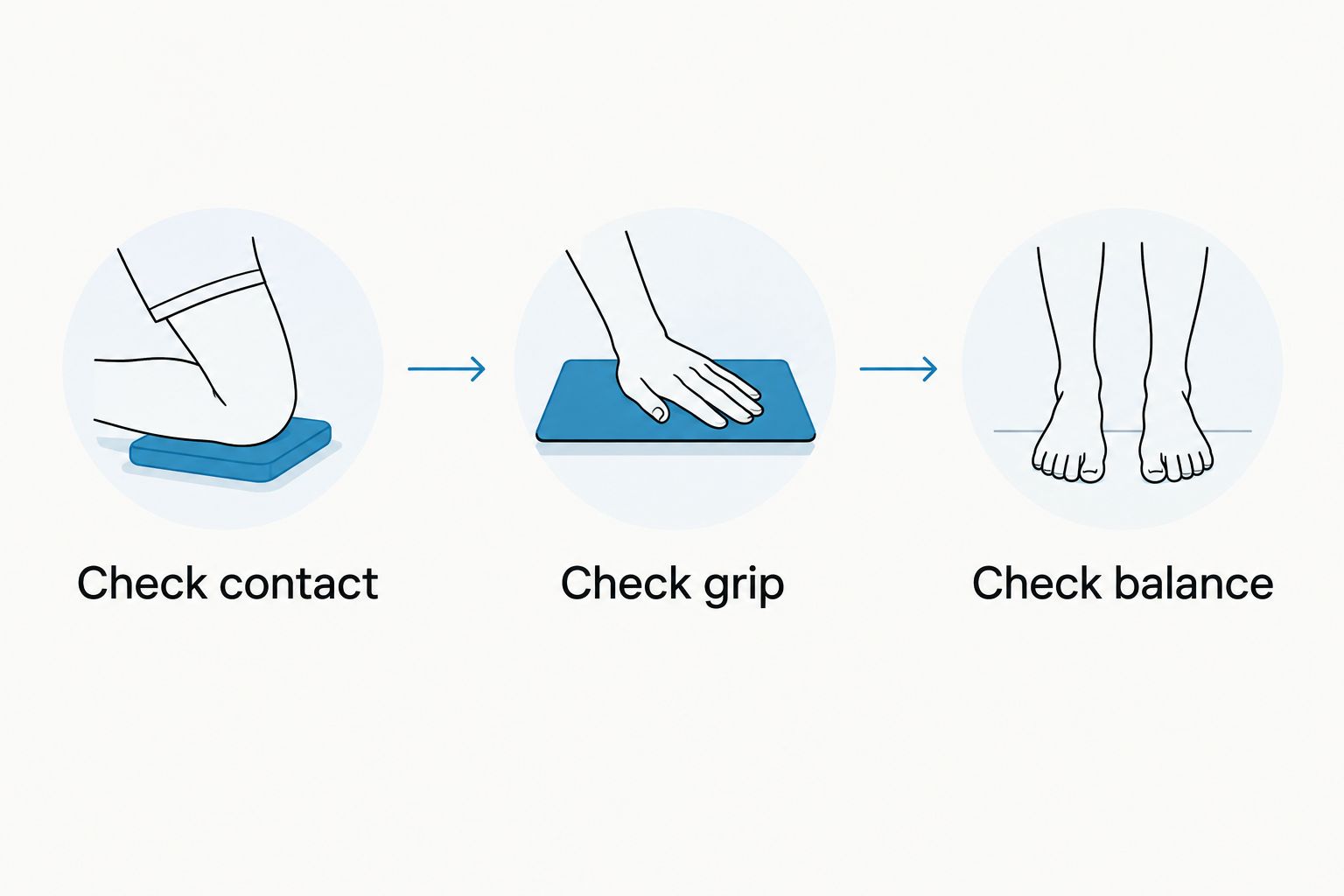
Repeat these checks with any extra padding you plan to use. Your 2026 buying checklist should reflect the complete setup, including the floor and additional layers, rather than the mat on its own.
Is a thicker yoga mat always better for knee pain?
A thicker yoga mat is not always better for knee pain. Extra material can help cushion contact, but softness, compression, grip, and the movement itself also affect your experience.
There is another distinction: pressure against the front of your knee is not the same as pain inside the joint. If bending or loading your knee causes pain, adding material beneath it does not resolve the underlying issue.
Choose equipment to make an appropriate movement more comfortable. Do not use equipment to justify continuing a movement that hurts.
Can you use a folded towel instead of buying another mat?
A folded towel is an option for adding local cushioning, provided it stays flat and secure. Place it beneath the knee contact area rather than leaving loose fabric across your standing surface.
The advantage is adjustability. The limitation is movement: fabric can bunch or slide, especially during transitions. Remove or reposition it before stepping onto an uneven edge.
Try the setup cautiously during a comfortable movement. If it shifts, makes balance awkward, or leaves the same pain unchanged, stop using that arrangement.
What should you check in a product listing?
Look for information that answers your actual use case. Is the item intended for active yoga practice, general floor exercise, stretching, or relaxation? Those descriptions are not interchangeable.
The TPE Folding Yoga Mat for Napping and Relaxation from Sweatjoy is described for midday naps and lounging. That stated purpose does not establish its suitability for painful kneeling or standing yoga. Do not turn a relaxation description into a knee-support claim.
Before choosing any mat, check:
- Whether the listing states its intended activity.
- Whether dimensions and thickness are provided.
- Whether the description explains the material and care requirements.
- Whether grip claims are actually stated rather than assumed.
- Whether the item matches your balance and floor-work needs.
For your 2026 shortlist, keep unknown features unknown. A product name, photo, or material label cannot confirm how a mat will feel beneath your knee.
When should you stop changing the mat and seek help?
Stop trying to solve persistent knee pain through equipment alone. A physiotherapist or other qualified healthcare professional can assess your symptoms and advise which movements are appropriate.
Seek urgent medical advice for severe pain, an inability to bear weight, a badly swollen or deformed knee, or a hot, red knee with fever. These are not shopping problems.
If symptoms are less urgent but keep returning, describe when they happen: direct kneeling, bending, standing up, twisting, or after practice. That information is more useful than simply saying your mat feels too thin.
Until you have appropriate guidance, leave out painful positions. A modified session is better than forcing a pose because you have bought extra padding.
FAQ
How thick should a yoga mat be for bad knees?
There is no single thickness that suits every painful knee. Choose a mat that cushions comfortable kneeling without making standing unstable, and stop any pose that hurts.
Is a very thick yoga mat better than a firm mat?
A very thick yoga mat is not automatically better than a firm mat. Compare how each compresses beneath your knees and how steady it feels beneath your feet.
Can I put a towel under my knees during yoga?
You can use a folded towel for local cushioning if it stays flat and secure. Reposition it before standing so you do not step onto loose or uneven fabric.
Why do my knees still hurt on a padded yoga mat?
Padding does not address every cause of knee pain. Stop the painful pose and seek assessment if symptoms persist or recur.
Should I choose a soft yoga mat for balance poses?
Choose a surface that feels stable beneath your feet for balance poses. Soft material that compresses unevenly can make a familiar standing position feel less controlled.
Can a yoga mat treat arthritis or a knee injury?
A yoga mat does not treat arthritis or a knee injury. It provides a practice surface; a qualified healthcare professional should advise on symptoms and suitable exercise.
What should I check before buying a yoga mat online?
Check the mat’s intended use, dimensions, stated thickness, material information, and care instructions. Do not assume a relaxation mat has features for active yoga or painful kneeling.
One last thing
Test the transition, not just the pose. Padding can feel comfortable while you are still, then shift as you move your knee or bring a foot forward. Check the movement into and out of a position before making that setup part of your routine.
Keep the final decision simple: comfortable contact, secure footing, and no pressure to continue through pain. More thickness is only useful when the whole setup works better for you.