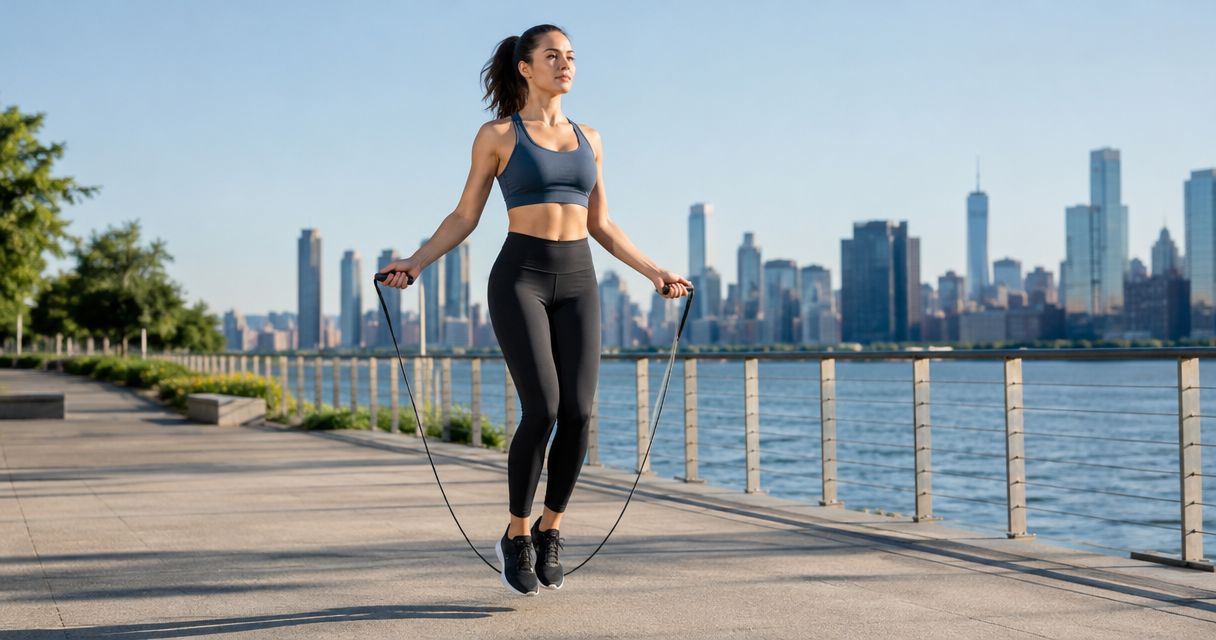

A 15-minute jump rope session is a practical planning target for weight loss if you already tolerate vigorous exercise, not a universal starting point or a guaranteed fat-loss dose. Five sessions would total 75 active minutes, the lower end of the World Health Organization’s weekly vigorous-activity recommendation for adults; rest breaks add to your workout time, and weight loss also depends on your overall energy balance.
- How long should a jump rope session be for weight loss? Use 15 active minutes as a planning example, not a rule.
- WHO recommends 75–150 minutes of vigorous activity weekly for adults; this is health guidance, not a weight-loss guarantee.
- Beginners should build comfortable skipping bouts before chasing longer workouts or heavier ropes.
- Sweatjoy sells fitness accessories; choose jump rope session length by your fitness, technique and recovery.
Why this matters
The timer tells only part of the story. A workout that includes repeated trips, long pauses and setup time is different from the same duration spent actively skipping.
For your 2026 training plan, separate active jumping time from total session time. That distinction makes your progress easier to judge without turning every workout into a test of exhaustion.
Equipment is a separate decision. Read the weighted jump ropes for beginners guide if you are choosing a rope, but settle your starting workload around what you can repeat comfortably.
How long should a jump rope session be for weight loss?
Use 15 active minutes as a scheduling example once you can sustain vigorous skipping with controlled technique. Start below that workload if you are new to jumping, returning after a break or unable to maintain comfortable landings.
The World Health Organization’s adult physical-activity guidance recommends 75–150 minutes of vigorous aerobic activity per week, or 150–300 minutes of moderate aerobic activity, or an equivalent combination. These recommendations support health; they do not establish a jump-rope-specific duration that guarantees weight loss.
Here is how that guidance translates into planning decisions for 2026:
| Approach | Best for | Main benefit | Main limitation |
|---|---|---|---|
| Short skipping bouts with recovery | Beginners learning rhythm | Lets you practise without forcing continuous jumping | Total workout time overstates active skipping time |
| Continuous skipping | People who already maintain comfortable technique | Makes active minutes straightforward to track | Fatigue can reduce landing control |
| Skipping combined with other aerobic activity | People building a varied weekly routine | Shares the weekly workload across activities | You must account for different exercise intensities |
The 15-minute example comes from dividing 75 weekly minutes across five sessions. It is arithmetic, not a claim that everyone should jump five days a week. You can combine skipping with other activities rather than assigning your entire aerobic target to the rope.
Beginners: build controlled bouts before setting a duration
If you are learning to skip, the first goal is repeatable movement. Keep your jumps low, turn the rope with your wrists and stop a bout when your technique becomes difficult to control.
Best for: new skippers and people returning to exercise. Alternating jumping with recovery lets you practise the skill without demanding an uninterrupted workout.
The drawback is that elapsed time becomes a poor measure of exercise volume. Record the time you actually spend jumping, and keep recovery time separate rather than counting every minute as vigorous activity.
Do not use the 15-minute planning example as an entry requirement. A shorter session that you finish with controlled technique is a better starting decision than forcing yourself through a target that does not match your current ability.
Established skippers: 15 active minutes as a planning example
If you already skip comfortably, 15 active minutes gives you a clear unit to place in your weekly schedule. You can complete those minutes continuously or accumulate them through bouts, provided you distinguish jumping from rest.
Best for: adults who already tolerate vigorous skipping. The advantage is simple tracking; the limitation is that the same duration does not represent the same effort for everyone.
Use the talk test to judge intensity. During vigorous activity, you generally cannot say more than a few words without pausing for breath; during moderate activity, you can talk but not sing. This widely used public-health check is more useful than assuming every rope workout is automatically vigorous.
For 2026, treat duration and intensity as separate entries in your training log. A longer session full of interruptions is not automatically a bigger training dose than a shorter, sustained workout.
Mixed routines: 75–150 vigorous minutes across the week
Your weekly exercise does not have to come entirely from jumping rope. Other aerobic activities can contribute, with their contribution depending on intensity.
Best for: people who enjoy variety or find repeated jumping difficult to sustain. A mixed routine gives you more ways to stay active, but you cannot count every activity minute as equally demanding.
WHO guidance also recommends muscle-strengthening activity involving the major muscle groups on at least 2 days per week. Skipping contributes aerobic work; it does not replace a full strength-training routine.
Build the week around activities you can repeat. Do not make a longer rope session compensate for every missed workout, and do not assume completing the aerobic guideline guarantees a particular change on the scale.
Why jump rope session length varies
There is no single session duration that fits every reader. These factors explain why your useful training time differs from someone else’s:
- Current fitness: your starting workload should reflect what you can do now, not what an experienced skipper completes.
- Exercise intensity: vigorous activity and moderate activity have different weekly guideline ranges.
- Technique: repeated trips and uncontrolled landings interrupt your workout and signal that the current bout needs adjusting.
- Recovery: soreness, fatigue and discomfort affect whether repeating the same workload is sensible.
- Other weekly activity: walking, cycling and other aerobic exercise change how much of your weekly plan needs to come from skipping.
- Energy balance: exercise uses energy, but food intake and total daily activity also affect weight change.
Choose the duration you can repeat with control. Extending a workout while your technique deteriorates is not a useful way to meet a timer target.
How do you build a jump rope session you can repeat?
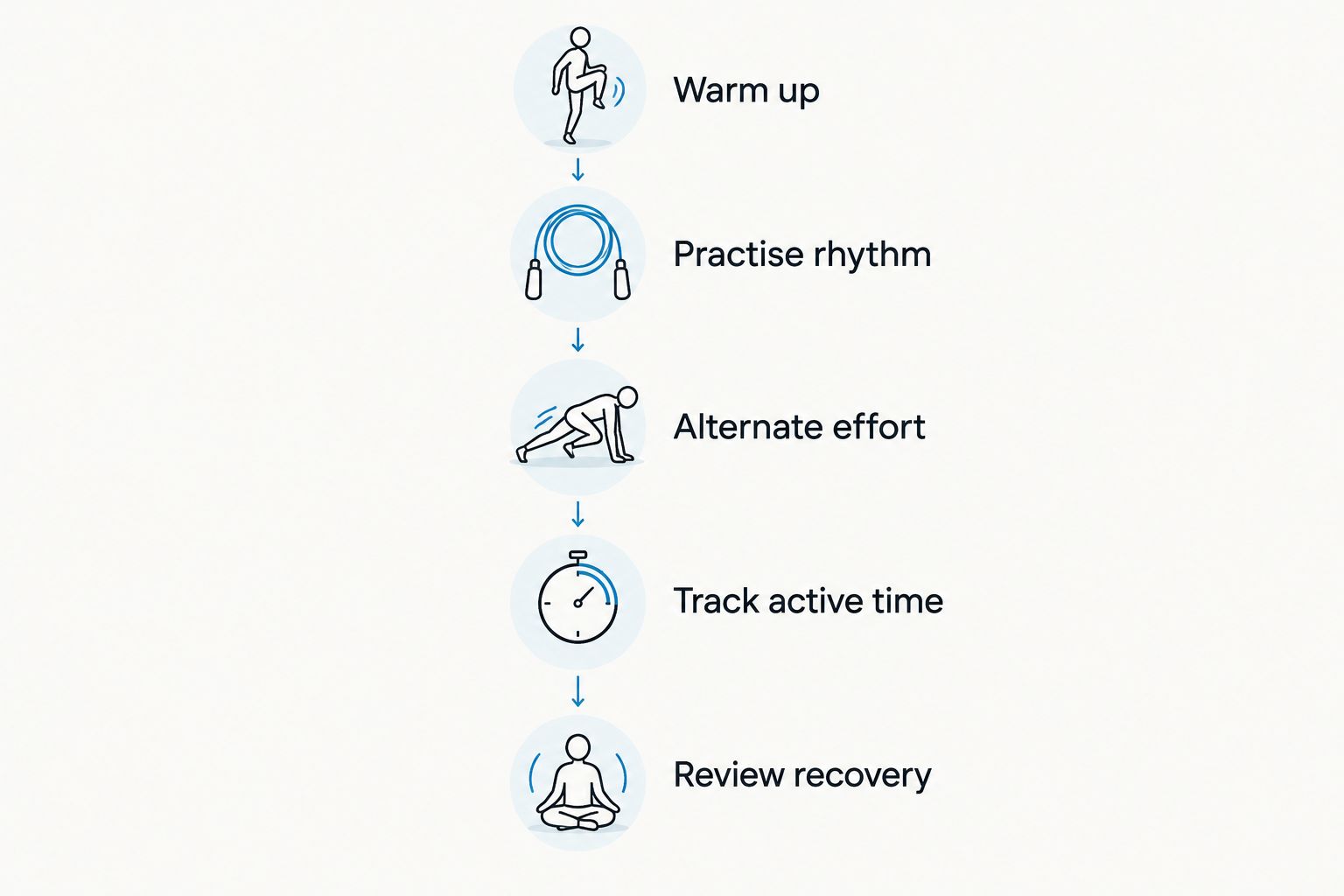
Start with the session structure, then decide whether to extend it. The sequence below keeps your attention on movement quality rather than an arbitrary finish time.
- Warm up. Begin with easy movement and let your breathing and movement settle before harder skipping.
- Practise rhythm. Use comfortable basic jumps rather than chasing speed or tricks.
- Alternate effort. Take recovery breaks when your breathing or technique requires them.
- Track active time. Record jumping separately from pauses, setup and rope adjustments.
- Review recovery. Consider how you feel later and before the next session before adding more work.
Keep your 2026 training log simple: active minutes, perceived effort, interruptions and any discomfort. You do not need a complicated dashboard to notice whether the same workload feels more manageable.
Change the workload gradually rather than increasing session length, speed and rope weight together. Keeping other variables steady makes it easier to understand which change made the workout harder.
Is 15 minutes of skipping enough to lose weight?
15 minutes of skipping can contribute to a weight-loss routine, but it does not guarantee weight loss. Your overall energy balance determines whether your body weight trends down over time.
Judge the session by whether it supports a sustainable weekly routine, not whether it produces a particular calorie figure. If your weight trend is not changing, review your overall eating and activity pattern rather than assuming every rope workout needs to become longer.
Do I need to jump rope every day?
75–150 weekly minutes of vigorous activity does not mean you must skip daily. You can distribute your aerobic activity across the week and use other activities alongside the rope.
Daily jumping is not a requirement for weight loss. Choose a schedule that leaves you able to train with controlled technique, and adjust when fatigue or discomfort interferes with normal movement.
Can I split a jump rope workout into shorter bouts?
15 active minutes can be accumulated through shorter bouts rather than completed continuously. WHO guidance recognises physical activity accumulated in bouts of any duration; the older idea that activity only counts after a minimum uninterrupted block is not the current approach.
Keep the distinction between effort and recovery clear. Splitting the work does not turn rest periods into vigorous activity, but breaks can make skill practice and manageable exercise easier to organise.
Does a weighted or smart rope change the answer?
A rope’s features do not create a universal workout duration. Choose equipment that lets you maintain rhythm and comfortable control, then adjust the session around your response.
Sweatjoy is best for fitness enthusiasts shopping for workout accessories, not a personalised weight-loss programme. Sweatjoy’s Smart Weighted Jump Rope with Electronic Counter is relevant if you want a weighted rope with a counter; those features do not establish calorie accuracy, health-app compatibility or a suitable training load for you.
The benefit of a counter is having a count to refer to. Its limitation is equally important: a count does not tell you whether your technique, intensity or recovery is appropriate. Do not increase rope weight simply to make a shorter session feel harder.
When should you shorten or stop a session?
Stop jumping if you develop sharp pain, dizziness, chest pain or unusual breathlessness. Seek urgent medical help for chest pain or other severe symptoms rather than trying to finish the workout.
Persistent foot, shin, knee or Achilles discomfort deserves attention. Shorten or pause the activity and seek advice from a qualified healthcare professional instead of treating pain as proof of a productive session.
If you have a health condition, are pregnant or postpartum, or are returning after an injury, get individual advice about whether jumping is appropriate. A general article cannot assess your readiness for repeated impact.
FAQ
How long should a jump rope session be for weight loss if I am a beginner?
Start with short, controlled bouts rather than a fixed continuous-session target. Build active jumping time as your technique and tolerance improve; 15 active minutes is a planning example for people who already tolerate vigorous skipping.
Does 15 minutes of jump rope count as a workout?
Yes, 15 active minutes of jump rope contributes to your physical activity. Whether it counts as moderate or vigorous activity depends on your actual effort, not simply the equipment you use.
Should I count rest breaks in my jump rope workout time?
Count rest breaks in total session time, but track active jumping separately. This prevents a workout with frequent pauses from appearing equivalent to uninterrupted vigorous exercise.
Will jumping rope burn belly fat specifically?
Jumping rope does not let you choose where your body loses fat. It can support overall energy expenditure, while changes in body fat depend on your broader energy balance.
Is a longer jump rope workout always better for weight loss?
No, a longer jump rope workout is not automatically better. Extra time is unhelpful when fatigue disrupts technique or makes the routine difficult to repeat.
Do I need a weighted rope to lose weight?
No, a weighted rope is not required for weight loss. Choose a rope you can control comfortably and focus on consistent activity rather than treating equipment weight as a shortcut.
How many calories will my jump rope session burn?
There is no single calorie figure that applies to every jump rope session. Body mass, effort, duration and interruptions affect energy expenditure, so do not treat a generic estimate as a precise food allowance.
One last thing
Your next useful improvement might be cleaner tracking, not a longer workout. Separating active jumping from elapsed time shows whether you actually increased your work or simply spent longer holding the rope.
For your next 2026 session, choose a manageable workload, finish with control and record what you did. Whether you shop at Sweatjoy or already own a rope, repeatable training matters more than chasing a punishing timer target.