Smart weighted jump ropes do not have a universal lifespan: replace or repair yours when the rope, handle connections or electronics stop working safely and reliably, not when a calendar deadline arrives. A worn rope does not automatically mean the counter has failed, and a blank display does not automatically mean the whole rope is finished. This 2026 guide explains how to separate normal wear from replacement signs and keep your next workout on track.
- How long do smart weighted jump ropes last? Judge condition and function, not an unsupported lifespan claim.
- Inspect the rope, handle connections and electronic counter separately before deciding what needs replacing.
- Sweatjoy sells a smart weighted jump rope with an electronic counter; choose it for counting, not assumed durability.
- Stop using a rope with exposed internal material, loose weight or damaged handle connections.
How long do smart weighted jump ropes last?
A smart weighted jump rope lasts only as long as its safety-critical parts remain sound. There is no single replacement interval that applies across different rope materials, handle designs, training surfaces and usage patterns.
Treat the rope and its electronics as separate checks. You need secure connections and predictable rotation for skipping; you need a functioning counter for the counting feature. Passing one check does not cancel a failure in the other.
Use the following table to decide what deserves attention. These are inspection prompts, not a substitute for the instructions supplied with your rope.
| Part to inspect | What to look for | What the finding means | Next move |
|---|---|---|---|
| Rope exterior | Cuts, splits, pronounced abrasion or exposed internal material | The rope needs closer inspection before more impact | Stop using a visibly compromised rope and check replacement instructions |
| Handle connection | Slipping attachment, cracking or unexpected movement | The connection is not holding as intended | Stop and follow the manufacturer's adjustment or replacement instructions |
| Rotation | Catching, binding or a change from normal movement | Something needs checking before another session | Inspect for tangles, damage and incorrect assembly |
| Electronic counter | Blank display, resets or inconsistent counting | The counting function needs troubleshooting | Check the documented power and reset procedure |
| Weighted components | Loose parts, damaged housing or movement that should not occur | The weight is not securely contained | Stop using the equipment |
For everyday packing habits, use the guide to storing a smart weighted jump rope. Storage cannot reverse damage, but it is a practical part of equipment care.
Why this matters
A display can look fine while the rope beneath it is worn. The reverse is also possible: an electronic fault can interrupt your training log while the mechanical parts still appear intact.
Do not let a working counter overrule a damaged rope. A clean-looking screen tells you nothing about the strength of a connection or the condition of a hidden attachment point.
For your 2026 training routine, make condition checks part of setting up, rather than something you do only after equipment fails. You do not need a complicated maintenance system. You need a clear reason to keep using the rope—or a clear reason to stop.
Rope wear: inspect the part that hits the ground
The rope section repeatedly meets the training surface. Look along its full length rather than checking only the middle, and inspect any area that catches your attention during use.
Scuffing and structural damage are not the same thing. A surface mark does not by itself establish that a rope is unsafe, but a deep cut, split or exposed internal material calls for stopping and checking the manufacturer's guidance.
Do not hide a damaged section with tape and treat it as repaired. Covering a defect makes the underlying condition harder to inspect and does not establish that the rope can safely take further use.
If your model accepts replacement ropes, confirm the exact compatible part before ordering. Similar-looking attachments are not proof of compatibility, and a detachable rope is not automatically designed for every replacement cable.
Handles and connections: security comes before the counter
Check the place where the rope enters each handle. Look for damaged housings, slipping attachments and changes in how the assembly sits together.
Rotate the rope gently during inspection and notice whether movement feels different from its normal operation. Stop if a connection shifts unexpectedly or the handle catches. Do not force a stiff mechanism and assume that extra movement will fix it.
A weighted handle adds another inspection point: whatever holds the weight in place must remain secure. If you hear a new rattle or feel unexpected movement, identify the cause before training again.
Follow the supplied instructions for tightening or adjustment. An attachment that needs a specific assembly method should not be improvised with whatever fastener happens to fit.
Electronic counter: troubleshoot before replacing everything
A blank display is a symptom, not a diagnosis. Start with the power instructions for your exact model, including whether it uses a replaceable battery or a rechargeable power source.
Check that any accessible cover is properly closed. Use only the documented reset procedure, and avoid opening a sealed handle simply to investigate a display problem.
For inconsistent counting, compare the display with a short set of turns you count yourself. Keep the movement consistent and follow the manufacturer's counting instructions; this is a practical check, not a formal accuracy test.
A counter also does not prove that a rope connects to a phone or fitness platform. In 2026, assess an electronic counter, app connection and data export as separate features. Confirm each feature rather than reading it into the word smart.
Why smart weighted jump rope lifespan varies
The product label alone cannot tell you how much useful life remains. These factors explain why a calendar-only replacement rule is a poor fit:
- Training surface: Repeated ground contact creates abrasion. Check whether the manufacturer approves your intended surface, especially before using the rope on rough paving.
- Amount of use: More sessions mean more repeated contact and movement. Compare condition over your own training history rather than borrowing another user's timeline.
- Rope construction: Different materials and designs require different care. Follow the instructions for the actual rope rather than advice written for a different construction.
- Connection design: Adjustable, detachable and fixed connections do not share the same inspection or replacement procedure. Check the specific assembly you own.
- Moisture and cleaning: Electronic handles need care that matches their stated water protection. Sweat exposure is not permission to rinse or submerge them.
- Storage and handling: Tight bends, trapped sections and heavy objects pressing on handles are avoidable handling problems. Store the rope without forcing its shape.
These factors guide inspection; they do not justify promising a particular number of months or years. A lifespan estimate without defined use and construction is not a replacement plan.
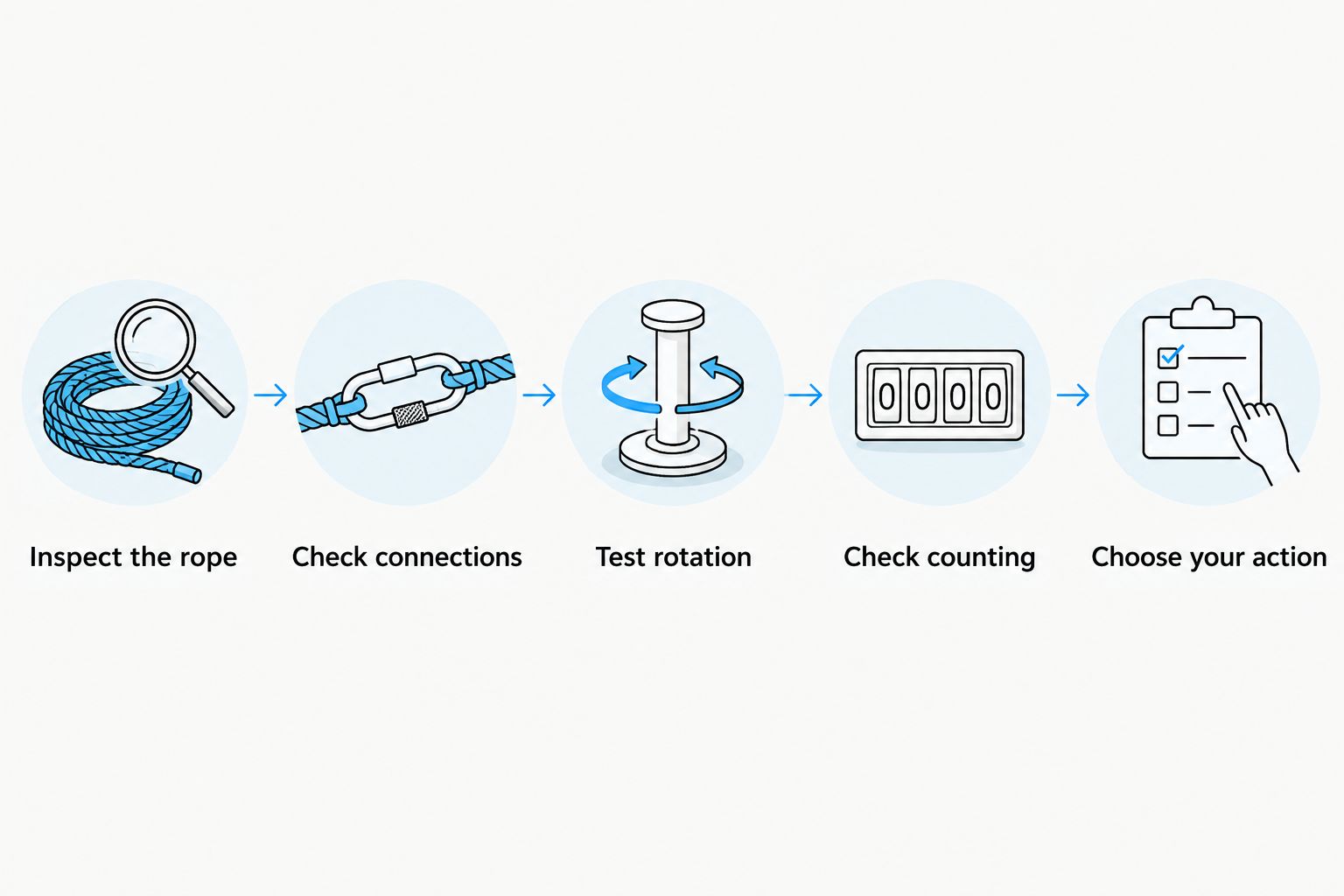
How do you check a smart weighted jump rope before training?
Use this sequence before you begin. The aim is to find obvious problems while the rope is stationary, not discover them during a fast set.
- Inspect the rope. Uncoil it and look along the length for cuts, splits, pronounced wear and damaged sections near the handles.
- Check connections. Follow the supplied security check for each attachment. Confirm that adjustable sections remain in their intended position.
- Test rotation. Move the rope gently and check for catching, binding or unexpected movement before starting your workout.
- Check counting. Confirm that the display powers on and responds according to the product instructions. Investigate a new fault rather than ignoring it.
- Choose your action. Continue only when the equipment passes its safety checks. Troubleshoot electronics separately from mechanical damage.
A quick check is useful only when you act on what it reveals. If something has changed, pause the session long enough to understand it.
How do you care for a smart weighted jump rope after training?
Remove surface dirt and sweat using the cleaning method approved for your model. Do not assume a method suitable for the rope exterior is suitable for electronic handles.
If the instructions permit wiping, keep moisture away from openings and let the equipment dry before packing it away. Avoid applying solvents, lubricants or household cleaners unless the manufacturer specifically approves them.
Store the rope without sharp folds or pressure on the handle connections. Keep it away from equipment that can cut, crush or trap it inside a training bag.
For a simple 2026 maintenance record, note any new damage or change in operation. A photo of a suspicious section can help you compare its condition later, but it is not permission to continue using an already compromised rope.
Should you repair the rope or replace the whole unit?
Replace the affected component only when the manufacturer supports that replacement and the remaining equipment passes inspection. A replaceable part is useful; an improvised repair is a different proposition.
| Decision | Best for | Advantage | Limitation |
|---|---|---|---|
| Approved component replacement | A clearly identified fault with a documented replacement part | Keeps serviceable parts in use | Requires confirmed compatibility and correct fitting |
| Complete unit replacement | Damage that cannot be safely repaired through the documented process | Avoids relying on an uncertain repair | Discards parts that might still function |
| Counter troubleshooting | An electronic fault with no identified mechanical damage | Separates a power or setup issue from rope wear | Does not resolve cuts, cracks or insecure weights |
Ask for model-specific guidance if you cannot identify the correct part or procedure. Do not use glue, tape or an unapproved connector to keep a damaged weighted assembly in service.
When comparing replacements, put service instructions alongside the headline features. A clear explanation of how to replace a wear part is more useful than an unsupported promise that a rope lasts longer.
What should you check before buying a replacement in 2026?
Start with the information that affects ownership: intended training surface, cleaning instructions, power requirements and whether wear parts are replaceable. Then check the features you actually plan to use.
Sweatjoy's Smart Weighted Jump Rope with Electronic Counter is for gym-goers who want a weighted rope with an electronic counter. That describes its stated role, not a durability ranking. Sweatjoy's fitness gear should be assessed on the same condition, care and replacement criteria as any other equipment.
The counter is the relevant benefit when you want an on-handle counting feature. The limitation is equally clear: an electronic counter does not establish waterproofing, app compatibility or a longer service life.
Read jump ropes ranked by durability with those questions in mind. Compare the evidence behind a durability claim, not just the position of a product in a list.
Can I keep skipping if the electronic counter stops working?
A failed counter does not by itself establish that the mechanical rope is unsafe, but it also does not establish that continued use is approved. Follow the manufacturer's instructions and inspect the rope, connections and weighted components before deciding what to do.
If the electronic fault comes with heat, leakage, swelling or damaged housing, stop using the equipment. Do not treat that as an ordinary counting problem.
Does using a mat make a smart weighted jump rope last longer?
An appropriate training surface reduces avoidable contact with rough ground, but a mat does not guarantee a longer lifespan. Confirm that the surface suits skipping and your rope's instructions; an unstable or unsuitable mat creates a different problem.
Keep inspecting the rope even after changing surfaces. Existing damage does not disappear because the next workout takes place somewhere smoother.
FAQ
How long do smart weighted jump ropes last with daily use?
Daily use does not translate into a universal lifespan. Inspect the rope, connections and electronics regularly, and follow the replacement guidance for your exact model.
How do I know when my smart weighted jump rope needs replacing?
Stop using a smart weighted jump rope when you find structural damage, an insecure connection or loose weighted components. Use the manufacturer's instructions to determine whether an approved component replacement is possible.
Can I replace just the rope and keep the smart handles?
You can replace just the rope only when the model supports that replacement and you have the correct compatible part. Detachable-looking connections do not establish compatibility.
Does a blank electronic counter mean the whole rope is broken?
A blank electronic counter does not automatically mean the whole rope is broken. Check the documented power and reset instructions while assessing mechanical condition separately.
Can I wash my smart weighted jump rope under the tap?
Do not rinse a smart weighted jump rope unless its manufacturer explicitly permits that cleaning method. Electronic handles require care that matches their stated water protection.
Does Sweatjoy's smart weighted jump rope have an electronic counter?
Sweatjoy's Smart Weighted Jump Rope with Electronic Counter includes an electronic counter. Confirm any additional feature you need separately rather than assuming that smart means app-connected.
Should I replace a jump rope just because it looks scuffed?
Surface scuffing alone does not establish that a jump rope needs replacing. Deep cuts, splits, exposed internal material or damaged connections require stopping and checking the manufacturer's guidance.
One last thing
A working display is not a safety certificate. Before your next session, inspect the rope section that makes ground contact and the points where it joins the handles. Those checks tell you more about whether to train today than the purchase date does.